


Editor’s Note
This article was originally published in 2023 and was completely reviewed, updated, and expanded in September 2026 to reflect current dementia care recommendations and provide additional practical guidance for family caregivers.
This article focuses on how to recognize pain in someone with dementia, especially when they can no longer tell you they hurt.
Once you’ve identified possible pain, continue with our companion guide:
👉 Managing Pain in Dementia: Treatment Options, Comfort Measures & When to Call the Doctor
In that article, you’ll learn about medications, non-drug comfort measures, positioning, heat and cold therapy, massage, when to call the doctor, and other ways to help relieve pain while keeping your loved one comfortable.
When Behavior May Be the Clue
Your loved one suddenly refuses to take a shower.
They push your hands away when you try to help them get dressed.
They stop eating as much as they normally do.
They become restless at night, start pacing, or seem more agitated than usual.
It is easy to look at these changes and think:
“The dementia is getting worse.”
But there is another question I want every dementia caregiver to learn to ask:
Could they be in pain?
Pain is one of the problems that can easily be missed in someone living with Alzheimer’s disease or another dementia.
As dementia changes the brain, a person may have more difficulty recognizing pain, understanding what they are feeling, finding the words to explain it, or telling you where it hurts.
They may never say:
“My shoulder hurts.”
Instead, they may refuse their bath because raising their arm hurts.
They may never say:
“I have a toothache.”
Instead, they may stop eating.
They may never say:
“My hip hurts when I stand.”
Instead, they may refuse to get out of their chair.
Sometimes, the behavior is the clue.
💜 When someone can no longer tell us what hurts, we have to learn to watch for what their behavior may be telling us.
Why Dementia Can Make Pain Harder to Recognize
Dementia does not mean a person no longer feels pain.
The problem is that dementia can change their ability to understand and communicate what they are experiencing.
As dementia progresses, your loved one may have trouble:
- Recognizing that the feeling they have is pain
- Figuring out where the pain is coming from
- Finding the words to describe it
- Remembering when the pain started
- Answering questions about how much it hurts
- Connecting their behavior with what their body is feeling
- Asking someone for help
This becomes especially important during the middle and later stages of dementia.
You may need to rely less on what your loved one tells you and more on what you observe.
🎥 Watch: Pain in Dementia — When Behavior May Be the Clue
Sometimes it’s easier to recognize pain when you can see how all the clues fit together.
In this video, I walk you through the signs of pain caregivers may miss, why a change in behavior may be an important clue, common causes of pain, and how to use the Dementia Detective process to investigate what you’re seeing.
You’ll also learn simple comfort measures, questions to discuss with the healthcare provider, and how to watch for signs that what you tried may be helping.
Caregiver Pearl:
Don’t automatically assume a new behavior is “just the dementia.” When something changes, ask: Could something hurt?.
Pain Doesn’t Always Look Like Pain
When most of us picture someone in pain, we think of someone saying, “Ouch,” holding the painful area, or asking for pain medicine.
Pain in someone with dementia may look very different.
Watch for changes such as:
- Grimacing or frowning
- Moaning, groaning, or calling out
- Guarding part of the body
- Pulling away when touched
- Moving differently
- Limping or refusing to walk
- Refusing to stand or transfer
- Restlessness or pacing
- Increased agitation
- Anger or aggression
- Resistance to bathing, dressing, or other care
- Trouble sleeping
- Eating less
- Becoming unusually quiet or withdrawn
- Increased confusion
- A sudden change in usual behavior
One sign by itself does not always mean someone is in pain.
The change from their normal behavior is often the important clue.
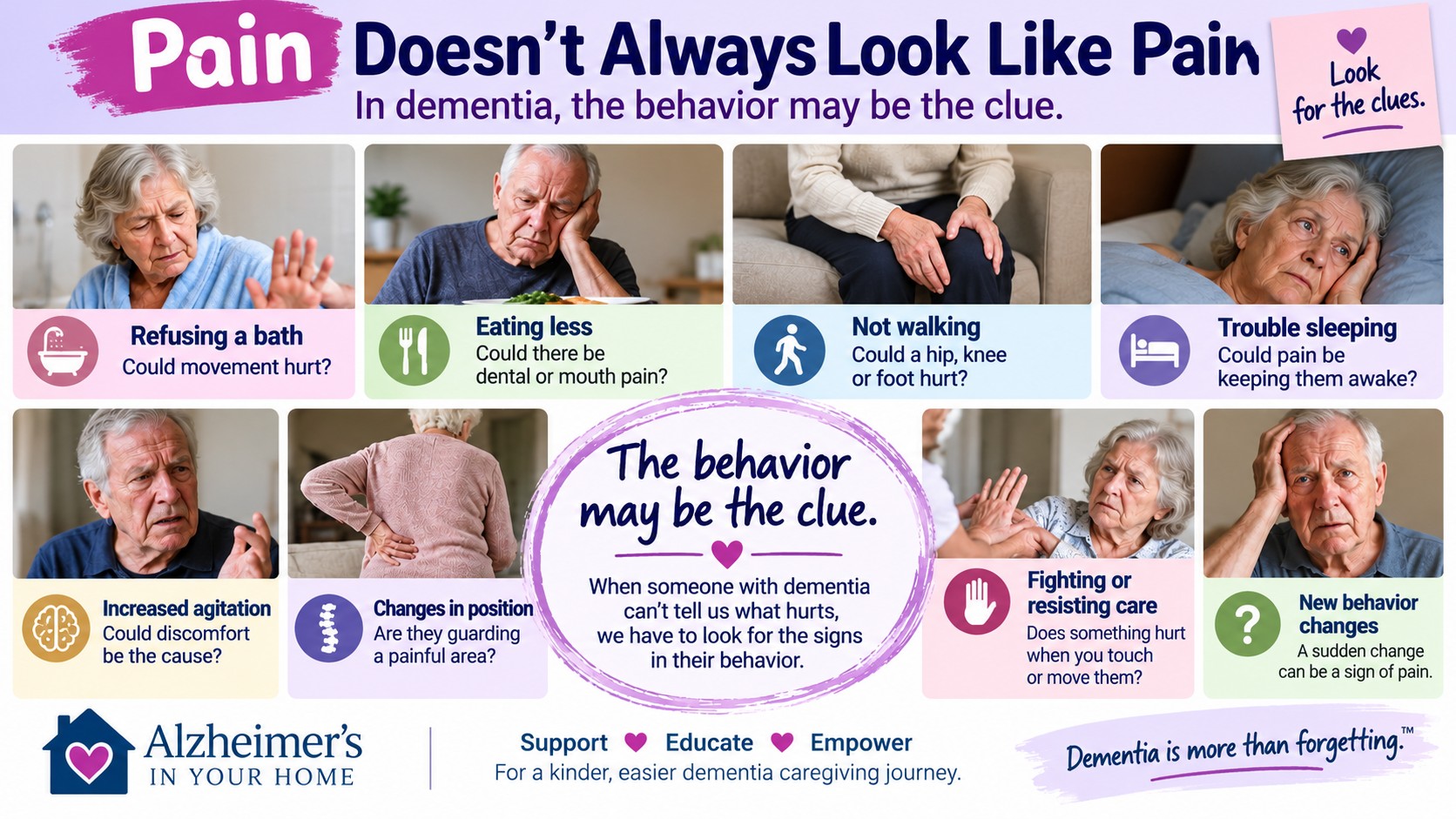
💜 “When words disappear, behaviors become the language of unmet needs.”
When a Dementia Behavior May Actually Be a Pain Clue
This is something I especially want caregivers to understand.
A behavior that looks like a “dementia behavior” may sometimes be your loved one’s way of protecting themselves from something that hurts.
Refusing a bath
Could their shoulder hurt when you lift their arm?
Could arthritis make stepping into the shower painful?
Could a bruise, skin tear, rash, pressure area, or other tender spot hurt when water touches it?
Refusing to get dressed
Does bending a knee or hip hurt?
Does lifting an arm hurt?
Is something rubbing against sore skin?
Refusing to walk
Could their hip, knee, back, ankle, or foot hurt?
Is there a blister, sore, swelling, or injury you haven’t noticed?
Eating less or refusing food
Could they have a toothache?
A mouth sore?
Poor-fitting dentures?
Pain when chewing or swallowing?
Becoming restless at night
Could arthritis, back pain, constipation, positioning, or another discomfort be keeping them awake?
Fighting or resisting care
Instead of immediately thinking:
“They won’t let me help.”
Try asking:
“Does something I’m doing hurt?”
That one change in thinking can lead you toward the real problem.
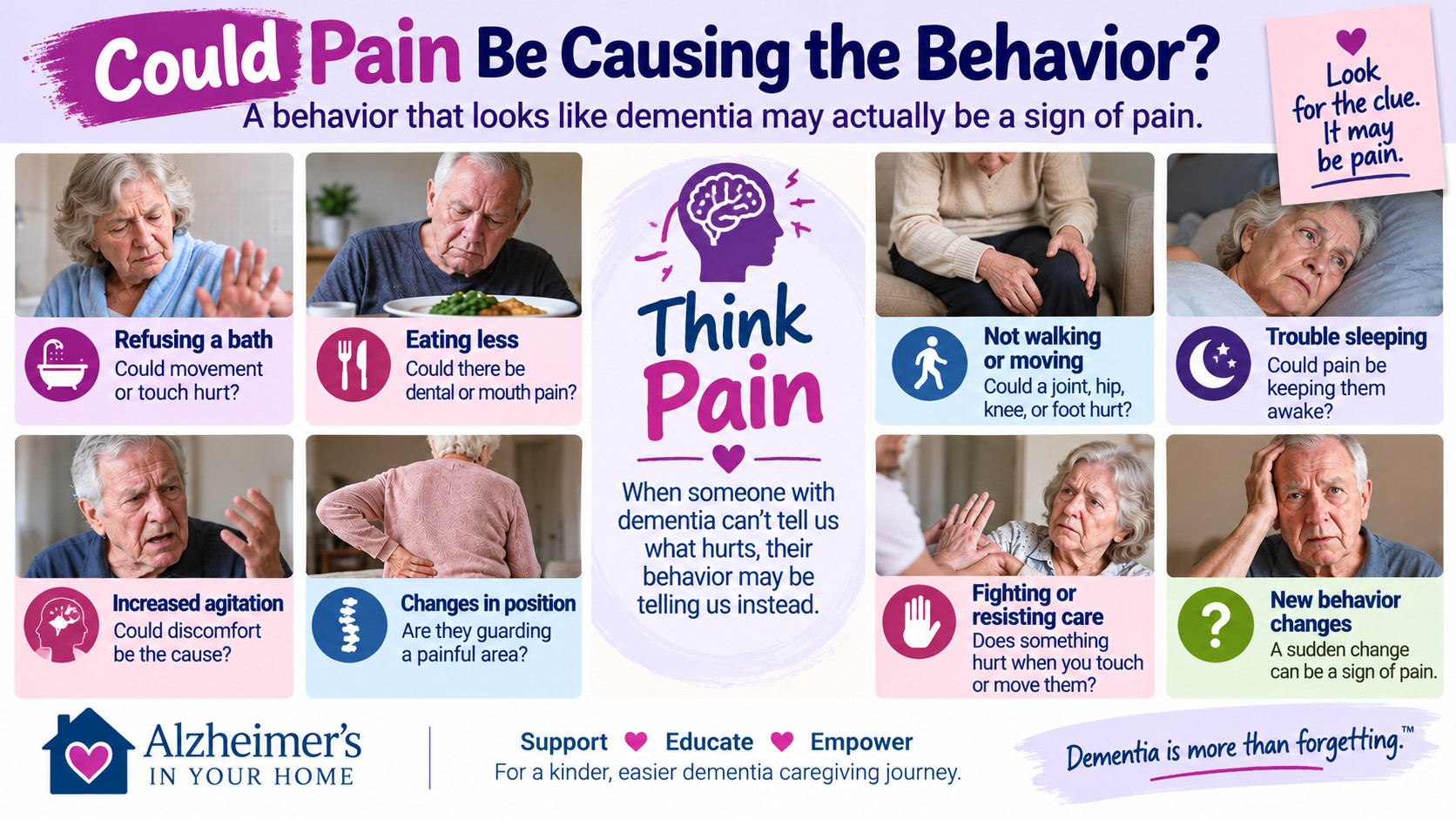
Common Causes of Pain in Older Adults With Dementia
Pain can come from many different places.
Some common causes include:
Arthritis and Joint Pain
Arthritis can make walking, standing, bathing, dressing, toileting, and getting in or out of bed uncomfortable.
Old Injuries
Old fractures, back injuries, surgeries, and joint problems may continue to cause pain.
Falls or New Injuries
Someone with dementia may fall or bump into something and be unable to explain what happened afterward.
Look for bruising, swelling, tenderness, changes in walking, or avoiding use of an arm or leg.
Constipation
Constipation can cause significant abdominal discomfort, restlessness, appetite changes, and behavior changes.
Dental and Mouth Problems
Cavities, broken teeth, gum problems, mouth sores, dry mouth, and poorly fitting dentures can make eating painful.
Skin Problems
Rashes, wounds, pressure injuries, skin tears, infections, and even irritated skin can hurt.
Urinary Problems
Urinary infections and other urinary problems may cause pain or discomfort along with changes in behavior or confusion.
Positioning
Sitting or lying in one position for too long can become uncomfortable, especially for someone with limited mobility.
New Illness or Medical Problems
Sometimes a behavior change may be the first sign that something new is happening medically.
This is why a sudden change should not automatically be blamed on dementia.
💜 “When behavior suddenly changes, always ask yourself: Could this be pain?”
🕵️ Become a Dementia Detective: Look for Pain Clues
When your loved one cannot clearly tell you what is wrong, it is time to become a Dementia Detective.
My Dementia Detective process is:
NOTICE → LOOK → ASK → TRACK → CONNECT
Let’s use it to investigate possible pain.
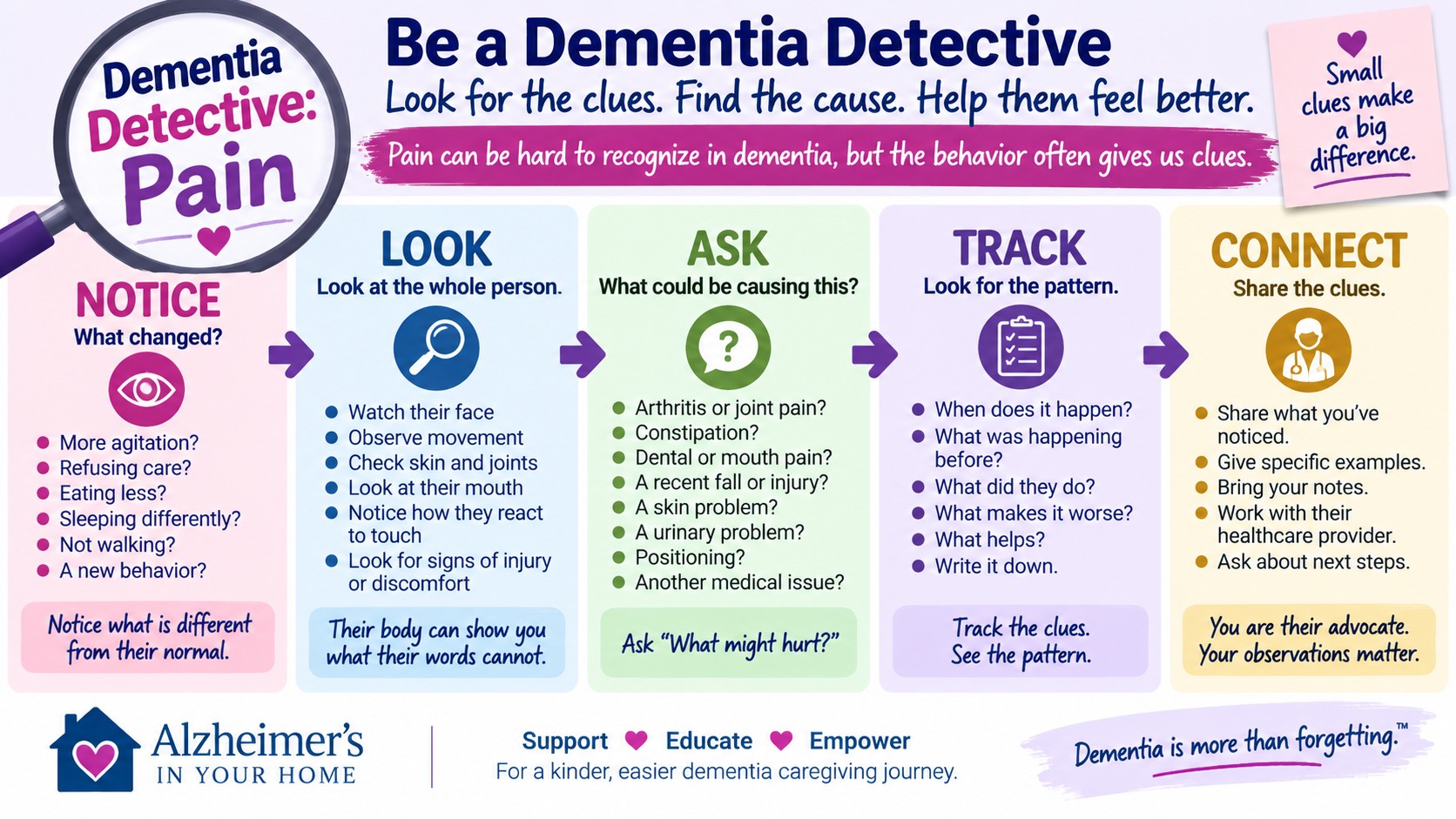
💜 “Pain is not a normal part of dementia, but it is a common part of aging.”
👀 NOTICE — What Changed?
Start with what is different.
Ask yourself:
- Are they suddenly more agitated?
- Are they sleeping differently?
- Are they eating less?
- Are they refusing something they normally do?
- Are they walking differently?
- Are they more confused than usual?
- Are they calling out or moaning?
- Are they guarding part of their body?
- Are they suddenly resisting care?
Don’t just focus on the behavior.
Notice what changed from their normal.
🔎 LOOK — Look at the Whole Person
Now look for physical clues.
Watch their:
- Face
- Body position
- Walking
- Movement
- Skin
- Mouth
- Feet
- Hands
- Joints
Pay attention when they move.
Do they grimace when standing?
Pull away when you touch a shoulder?
Avoid putting weight on one leg?
Become upset when you help them roll over in bed?
Sometimes their body will show you what their words cannot.
❓ ASK — What Could Be Causing This?
Now start thinking about possible causes.
Could it be:
- Arthritis?
- Constipation?
- Dental pain?
- A recent fall?
- A bruise?
- A skin problem?
- A pressure area?
- A urinary problem?
- An infection?
- An old injury?
- A new injury?
- Positioning?
- Another medical problem?
Also think about what was happening right before the behavior started.
That can provide another important clue
📝 TRACK — Look for the Pattern
You don’t need pages of notes.
Write down a few simple details:
When did it happen?
What was happening right before it?
What did your loved one do?
Where did they seem uncomfortable?
What made it worse?
What seemed to help?
For example:
Monday, 8 AM: Mom yelled when I lifted her right arm to put on her shirt.
Tuesday, 7:30 AM: Pulled away when washing under right arm.
Wednesday, 8 AM: Refused shirt and guarded right shoulder.
Now you have something much more useful than:
“Mom has been difficult during morning care.”
You have a pattern.
🤝 CONNECT — Share the Clues
Once you have gathered the clues, share them with your loved one’s healthcare provider.
Instead of saying:
“Dad has been really agitated lately.”
You might be able to say:
“For the last four days, Dad becomes very agitated when he stands. He grimaces, grabs his right hip, and doesn’t want to put weight on that leg. This started after he fell beside the bed.”
That gives the healthcare provider much more useful information.
As a caregiver, you are often the healthcare team’s eyes and ears at home.
The details you notice matter.

🧰 Free Dementia Caregiver Tools
Tracking the clues is only helpful if you can share what you’re seeing.
The free Dementia Caregiver Doctor Update Form can help you organize important changes, concerns, and questions before a medical appointment.
Use it to share changes in:
✓ Pain or discomfort
✓ Behavior or confusion
✓ Sleep and eating
✓ Walking and mobility
✓ Daily care needs
✓ Other new or concerning symptoms
What Should You Track When You Suspect Pain?
Try to record:
- When the change started
- Where the pain may be
- What the person was doing when it happened
- Facial expressions
- Changes in walking or movement
- Changes in sleep
- Changes in appetite
- Changes in behavior
- What makes it worse
- What makes it better
- Any falls or injuries
- Recent medication changes
- What you tried
- Whether it helped
You may begin to see a pattern that wasn’t obvious before.
Pain Assessment Tools for Dementia
Healthcare professionals sometimes use special pain assessment tools when someone cannot clearly describe how they feel.
These tools do not diagnose the cause of pain. They help caregivers and healthcare professionals look more closely for signs of possible discomfort.
PAINAD — Pain Assessment in Advanced Dementia
PAINAD looks at five areas:
- Breathing
- Negative vocalizations such as moaning or crying
- Facial expressions
- Body language
- Consolability
It can be especially useful when someone with advanced dementia can no longer reliably tell you whether they hurt.
Faces Pain Scale
Some people in the earlier stages of dementia may still be able to point to a face that best represents how they feel.
This can sometimes be easier than asking:
“On a scale of 1 to 10, how bad is your pain?”
Other Observation Tools
Healthcare settings may use other tools to assess pain in people who have difficulty communicating.
The important lesson for family caregivers isn’t memorizing every pain scale.
It is learning to observe changes, look for patterns, and report what you see.
📒 Write Down the Clues
Pain can be especially difficult to figure out when the signs come and go.
You may notice something on Monday and something different on Wednesday without realizing they are connected.
Writing things down helps you put those clues together.
The Dementia Caregiver’s Notebook was designed to help caregivers track changes such as:
- Pain
- Behaviors
- Sleep
- Medications
- Meals
- Bowel patterns
- Vital signs
- Changes in daily care
Having this information in one place can also make it much easier to prepare for doctor visits and share clear information with other people helping with your loved one’s care.
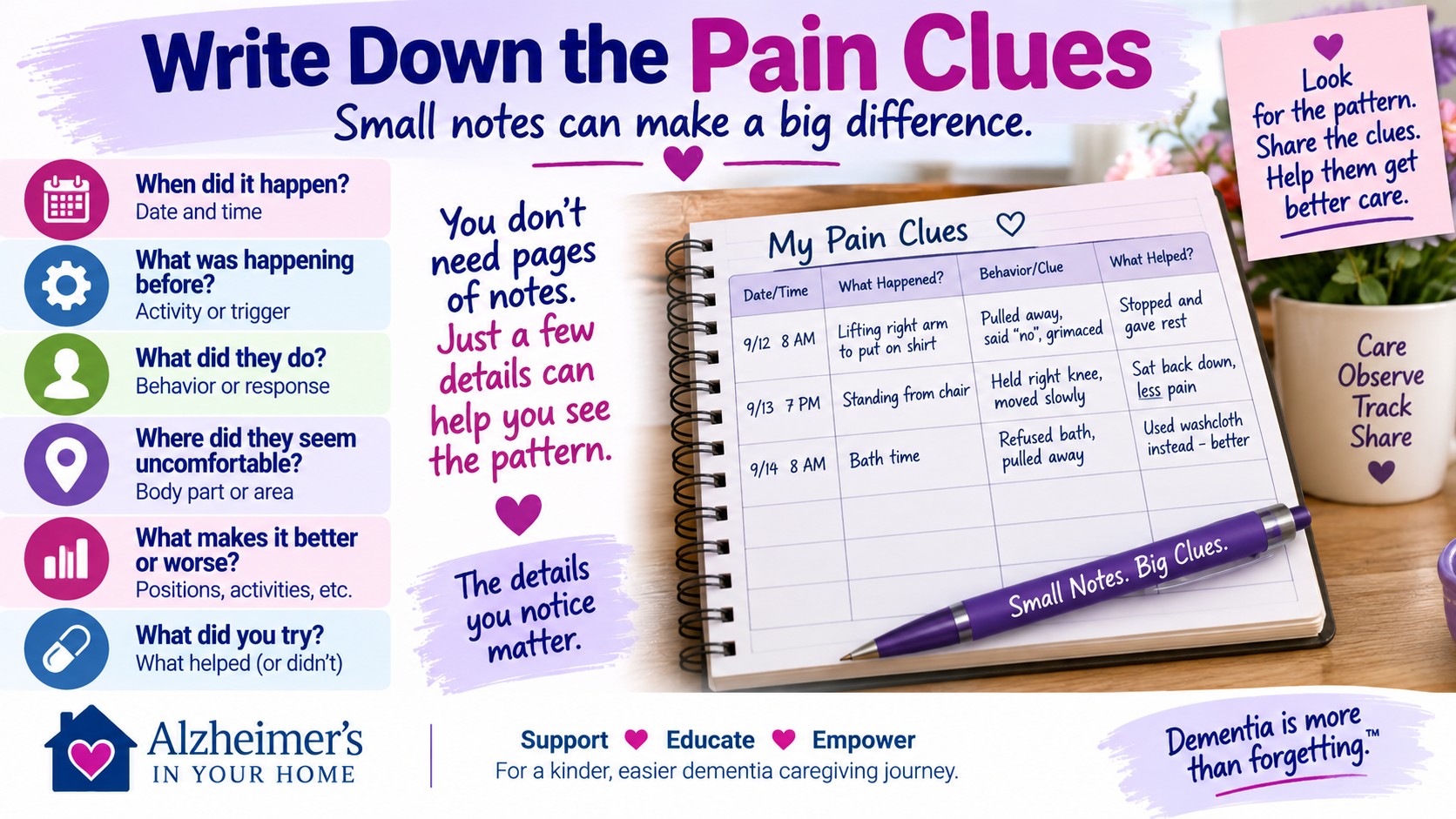
💜 “Behaviors are often symptoms. The caregiver’s job is to discover what the symptom is trying to say.”

When Should You Contact the Healthcare Provider?
Contact your loved one’s healthcare provider when you notice new, persistent, worsening, or unexplained signs of pain.
This is especially important when there is:
- A sudden change in behavior or function
- New trouble walking or standing
- Pain after a fall or injury
- New swelling or bruising
- Persistent crying, moaning, or guarding
- New difficulty eating or drinking
- New abdominal discomfort
- A wound or skin problem
- Pain that continues or keeps returning
- A major change from their normal behavior
Seek urgent or emergency medical help for serious symptoms such as severe injury, trouble breathing, chest pain, uncontrolled bleeding, sudden one-sided weakness, loss of consciousness, or another medical emergency.
When you’re unsure how serious a new change may be, contact their healthcare provider for guidance.
What Can You Do When You Think Your Loved One Is in Pain?
Recognizing pain is the first step.
The next step is figuring out why they hurt and what can safely be done to make them more comfortable.
Pain management may include simple comfort measures, changes in positioning or activity, treating the underlying cause, or medications recommended by their healthcare provider.
I have a separate guide that walks you through those next steps:
How to Manage Pain in Alzheimer’s and Dementia
In that article, we’ll look at:
- Non-medication comfort measures
- Positioning
- Heat and cold
- Gentle massage
- Pain medications
- What to discuss with the healthcare provider
- When pain needs medical attention
Don’t Automatically Blame Dementia
This may be the most important thing I want you to take away from this article.
When someone with dementia suddenly becomes agitated, stops eating, refuses a bath, won’t walk, can’t sleep, or begins resisting care, it is easy to think:
“It’s the dementia.”
Sometimes dementia is part of the reason.
But sometimes their behavior is trying to tell you:
Something hurts.
So before focusing only on stopping the behavior, stop and ask:
“Could this be pain?”
Then:
NOTICE → LOOK → ASK → TRACK → CONNECT
Notice the change.
Look for clues.
Ask what could be causing it.
Track the pattern.
Connect with the healthcare provider.
That is what being a Dementia Detective is all about.
Frequently Asked Questions About Dementia and Pain
Do people with dementia still feel pain?
Yes. Dementia does not mean someone no longer experiences pain. What often changes is their ability to recognize, describe, remember, or communicate what they are feeling.
Can pain cause behavior changes in dementia?
Pain or discomfort can contribute to changes such as agitation, restlessness, resistance to care, sleep problems, decreased activity, or changes in eating.
That is why a new behavior deserves a closer look.
How can I tell if someone with dementia is hurting?
Look for changes in facial expressions, body language, movement, sleep, appetite, vocalizations, activity, and behavior. Compare what you are seeing with what is normal for that person.
Why does my loved one fight me during personal care?
There can be many reasons, including fear, confusion, feeling rushed, loss of privacy, or difficulty understanding what you are doing.
But pain should also be considered.
Watch whether resistance happens during a particular movement, position, or part of the care.
Should I tell the doctor about a sudden behavior change?
Yes. A sudden or significant change should not automatically be blamed on dementia. Pain, illness, injury, constipation, medication effects, and other medical problems may need to be considered.
Final Thoughts
One of the most important lessons I’ve learned from caring for people living with dementia is that we have to look beyond the behavior.
The person in front of us may no longer be able to explain what their body is telling them.
They may not be able to say:
“That hurts.”
But they may still be telling us.
Through a grimace.
Through pulling away.
Through refusing to stand.
Through not eating.
Through waking during the night.
Or through a sudden behavior that seems to come out of nowhere.
Don’t just ask:
“How do I stop this behavior?”
Ask:
“What is this behavior trying to tell me?”
And sometimes, the answer may be:
Pain.
💜 Look for the clue. Write it down. Watch for the pattern.
💜 “The goal is not just longer life — it is greater comfort.”



0 Comments