


There often comes a point in the dementia journey when families begin asking one of the hardest questions of all:
“Can we still safely manage this at home?”
For many caregivers, this question brings guilt, fear, sadness, and overwhelm. Some families never planned on needing outside help. Others promised they would “never put them in a facility.” But dementia is progressive, and as care needs increase, safety and medical needs can sometimes become more than one person can handle alone.
The truth is… needing more help does not mean you failed. 💜
Sometimes the most loving thing a caregiver can do is recognize when more support may be needed.
Unfortunately, many families are forced to make these decisions during a crisis:
- after a hospital stay
- after a fall
- after wandering
- after caregiver burnout
- after aggressive behaviors increase
- after care becomes unsafe at home
That is why understanding assisted living, memory care, nursing homes, dementia care costs, and how to find good facilities BEFORE a crisis happens can make a huge difference.
💜 “The best decisions are often made before the emergency happens.
Why Families Get Confused About Dementia Facilities
One of the biggest problems families face is that the terms:
- Assisted Living
- Memory Care
- Skilled Nursing
- Nursing Home
- Rehabilitation
- Long-Term Care
are often used interchangeably — even though they provide very different levels of care.
To make things even more confusing:
- every state has different rules
- facilities offer different services
- some facilities “accept dementia” but are not truly dementia-friendly
- dementia care costs vary greatly
- Medicare and Medicaid coverage can be confusing
Two facilities can look very similar online and provide completely different levels of care.
That is why families need to know what to look for.
💜 Understanding Dementia Can Help Families Make Better Care Decisions
Many caregivers struggle with facility decisions because they do not fully understand how dementia changes the brain, behaviors, safety awareness, and daily functioning over time.
The more families understand dementia progression, the easier it becomes to recognize:
- when more help may be needed
- what level of care is safest
- what changes may be coming next
- why certain behaviors happen
If you are new to the dementia journey, my beginner-friendly course may help you better understand what is happening and how to prepare.

🏡 What Is Assisted Living?
Assisted living facilities are designed for people who still have some level of independence but need help with daily tasks.
They often help with:
- meals
- medication reminders
- housekeeping
- bathing
- dressing
- transportation
- basic supervision
Many assisted living facilities have apartments or private rooms and try to create a more home-like environment.
Assisted Living May Work Best When:
- dementia is still in earlier stages
- the person can still communicate basic needs
- wandering is not severe
- behaviors are manageable
- they can still participate somewhat independently
Assisted Living May NOT Be Safe When:
- wandering becomes frequent
- nighttime confusion increases
- falls become common
- aggression develops
- medications are refused
- the person cannot safely toilet independently
- they need 24-hour supervision
Some assisted living facilities also have separate memory care units attached to them.
🌿 “A beautiful building does not always mean good dementia care.”

🧠 What Is Memory Care?
Memory care is designed specifically for people living with dementia.
These units are usually:
- secured for wandering safety
- more structured
- staffed by caregivers trained in dementia care
- focused on routines and supervision
Memory care facilities often provide:
- medication management
- cueing and redirection
- behavior monitoring
- structured activities
- increased supervision
- dementia-friendly environments
The goal is to provide both safety and quality of life.
Good Memory Care Facilities Often:
- keep residents engaged
- use calm communication
- understand sundowning
- redirect behaviors gently
- provide consistent routines
- encourage dignity and independence when possible
Not All Memory Care Facilities Are Equal
Some facilities are wonderful.
Others may struggle with:
- understaffing
- poor dementia training
- high staff turnover
- lack of supervision
- overmedication
- poor communication with families
Trust your gut when touring a facility.
Many families searching for memory care facilities are surprised by how much memory care costs can vary from one community to another.

🚩 Dementia Facility Red Flags
Pay attention to what you SEE, HEAR, and FEEL when visiting.
Warning Signs May Include:
- strong urine odors
- unanswered call lights
- residents left unattended
- residents sleeping in wheelchairs all day
- little interaction from staff
- staff talking over residents instead of to them
- rushed caregivers
- irritated tones
- poor cleanliness
- residents appearing heavily sedated
- no activities happening
Visit more than once if possible.
Try visiting:
- mornings
- evenings
- weekends
Facilities can look very different depending on staffing.
💜 “Families should never feel guilty for asking hard questions about care.”

🏥 What Is a Skilled Nursing Facility or Nursing Home?
Skilled nursing facilities provide the highest level of daily medical care outside of a hospital.
These facilities usually care for people who:
- are bedbound
- require lifts/transfers
- have feeding tubes
- need wound care
- need extensive assistance
- have frequent medical problems
- require 24-hour nursing supervision
Some nursing homes have special memory care units, while others care for residents with many different medical conditions together.
Nursing Homes Are Often Needed When:
- medical needs become complex
- mobility becomes very limited
- total care is required
- behaviors become unsafe
- hospice or extensive nursing care is needed
Many families begin researching nursing homes when they realize long-term dementia care at home is no longer safe.

💰 Understanding Dementia Care Costs
One of the biggest fears families have when looking at assisted living, memory care, or nursing homes is:
“How are we going to pay for this?”
Unfortunately, long-term dementia care costs can become very expensive, especially as care needs increase over time.
Many families are shocked to learn that Medicare does NOT usually pay for memory care or long-term nursing home placement.
Understanding the difference between Medicare, Medicaid, private pay, and long-term care insurance can help families plan ahead before a crisis happens.
💜 “Many caregivers are financially overwhelmed long before they ask for help.”
🏡 Assisted Living Costs
Assisted living is usually paid for privately.
Monthly costs vary greatly depending on:
- location
- level of help needed
- apartment size
- medication management
- extra care services
Many assisted living facilities charge:
- a base monthly fee
PLUS - additional care fees as needs increase
Important:
Most assisted living facilities are NOT covered by Medicare.
Some states offer limited Medicaid waiver programs for assisted living, but availability varies greatly and waiting lists can be long.
🧠 Memory Care Costs
Memory care is usually more expensive than standard assisted living because:
- supervision is higher
- staffing needs are greater
- dementia care requires more support
- facilities are secured for safety
Families often search:
- does Medicare pay for memory care?
- how much does memory care cost?
- does Medicaid pay for memory care?
In most situations, memory care is primarily private pay.
Families may pay using:
- savings
- retirement income
- home sales
- long-term care insurance
- veteran benefits
- Medicaid programs in certain states
🏥 Nursing Home Costs
Nursing homes can be extremely expensive without financial assistance.
This is where Medicare nursing home coverage and Medicaid nursing home coverage become confusing for many families.
❓ Does Medicare Pay for Nursing Homes?
Medicare DOES NOT usually pay for long-term dementia care.
This surprises many families.
Medicare MAY cover:
- short-term rehabilitation
- skilled nursing care AFTER a hospital stay
- physical therapy
- occupational therapy
- temporary rehab stays
But Medicare coverage is usually:
- temporary
- medically necessary
- based on rehabilitation goals
Once rehab ends, families are often responsible for ongoing long-term care costs.
❓ What About Medicaid?
Medicaid is different from Medicare.
Medicaid MAY help pay for long-term nursing home care if:
- the person financially qualifies
- medical criteria are met
- state requirements are met
Many caregivers specifically search:
- does Medicaid pay for nursing homes?
- Medicaid nursing home eligibility
- how to qualify for Medicaid dementia care
Medicaid rules vary by state.
Some states also offer:
- Medicaid waiver programs
- home care assistance
- assisted living support programs
But many programs have:
- waiting lists
- financial limits
- strict eligibility rules
🌿 “Many families wait too long to explore financial options because they assume they still have more time.”

🔍 How to Find GOOD Dementia Facilities
Finding a good facility takes more than looking at photos online.
🔍 Start With State Inspections & Nursing Home Reports
One of the best places families can begin researching nursing homes is the:
👉 ProPublica Nursing Home Inspect Database
This free tool allows families to:
- search nursing homes by state or facility name
- review inspection reports
- compare deficiencies
- view fines and staffing information
- look for patterns of serious care concerns
The database uses government inspection information from the Centers for Medicare & Medicaid Services (CMS).
While no website can fully tell you what a facility is like day-to-day, this can be a very helpful starting point when researching local care options.
📝 Questions Families Should Ask
When touring a facility, ask questions like:
- How much dementia training do staff receive?
- Is there a nurse overnight?
- How do you handle wandering?
- What happens if behaviors increase?
- How often are families updated?
- How do you manage falls?
- What activities are offered daily?
- How do you help residents who refuse care?
- Can residents stay here as dementia progresses?
- What would require another move later?
Take notes during every tour.
Facilities can blur together quickly when you are overwhelmed.
🌿 “The goal is not just safety — it is dignity, comfort, and quality of life.”
Watch the Residents
One of the most important things families can do is quietly observe the residents already living there.
Ask yourself:
- Do they appear clean?
- Are they engaged?
- Are staff interacting kindly?
- Do residents seem calm or distressed?
- Does the environment feel warm and respectful?
You can often learn more by watching than by listening to a sales presentation.
Don’t Wait Until There Is a Crisis
Many caregivers wait until exhaustion, wandering, falls, or medical crises force difficult decisions very quickly.
If you are struggling to know whether it may be time for additional help, this article may help:
How to Know When It’s Time to Get Help for Alzheimer’s or Dementia
Many families wait too long because:
- they feel guilty
- they are overwhelmed
- they promised never to place them
- they are hoping things improve
But crisis decisions are often the hardest decisions.
Researching facilities early gives families:
- more choices
- more time
- less pressure
- better planning
- safer transitions
Even if you are not ready today, it helps to know your local options.
❓ Q & A for Families
Q: When is it time to consider memory care?
Usually when safety, wandering, behaviors, falls, or caregiver exhaustion become difficult to manage at home.
Q: Does moving to memory care mean I failed?
Absolutely not. Dementia eventually requires more care than one person can safely provide in many situations.
Q: Are all memory care facilities locked?
Most are secured to help prevent wandering and unsafe exits.
Q: Can someone with dementia stay in assisted living forever?
Sometimes, but many people eventually need more supervision and support than assisted living can safely provide.
Q: Should I tour more than one facility?
Yes. Always compare several facilities if possible before making decisions.
📘 Free Resource for Families
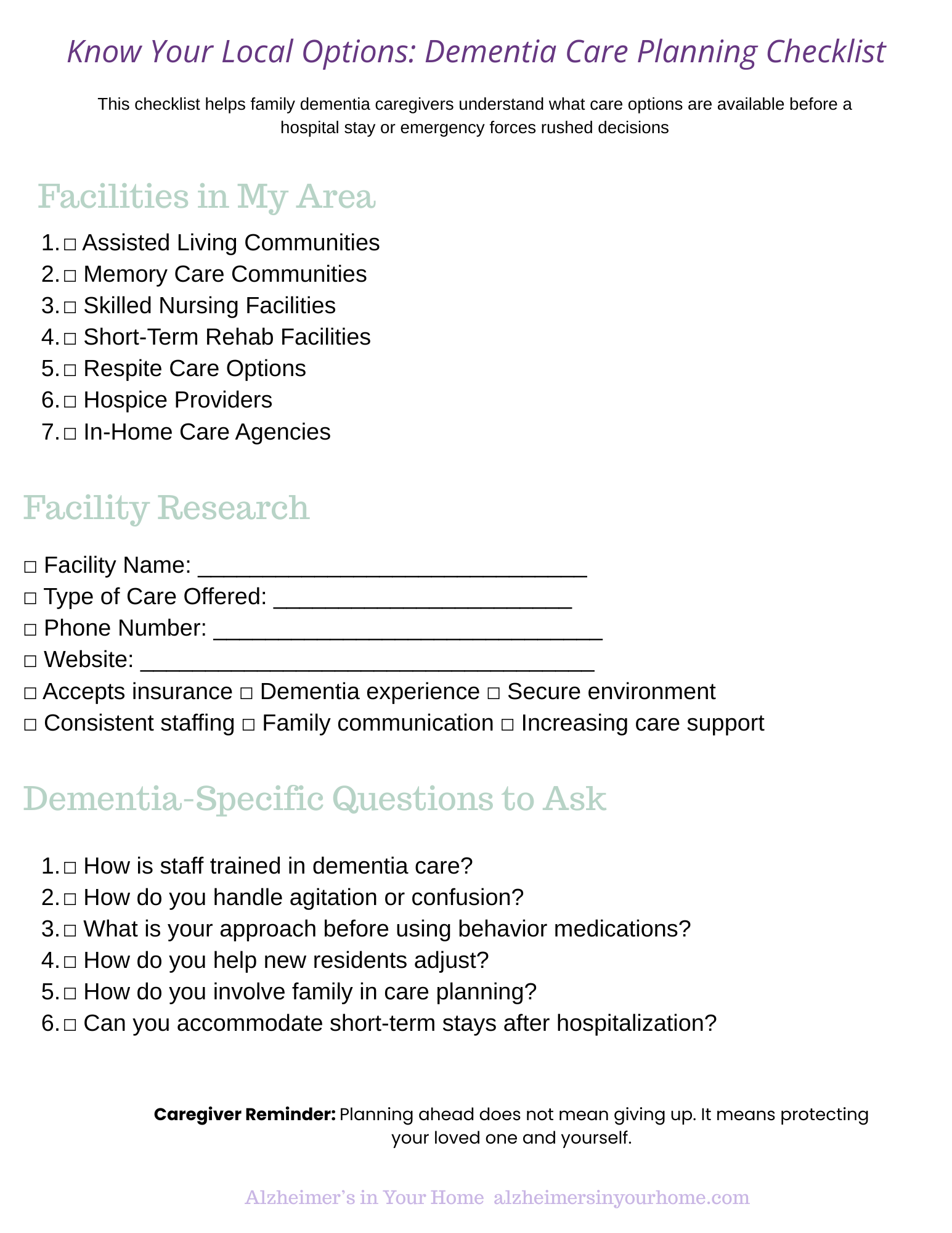
Know Your Local Options: Dementia Care Planning Checklist
Trying to compare dementia facilities can feel overwhelming fast.
That is why I created a simple checklist to help caregivers:
- compare facilities
- organize important questions
- track concerns
- prepare before a crisis happens
👉 Download the free resource here:
🧰 More Dementia Caregiver Tools & Resources
If you are trying to organize care, prepare for future needs, or navigate difficult dementia changes, you can also explore the free:
Inside you’ll find:
- printable caregiver forms
- hospital tools
- safety resources
- planning checklists
- dementia caregiving guides
- caregiver support resources
💜 “Sometimes asking for more help is one of the most loving choices a caregiver can make.”
🌿 Final Thoughts
Many caregivers carry overwhelming stress, guilt, grief, and exhaustion long before they begin considering outside care.
If that sounds familiar, you are not alone.
You may also find comfort in reading:
The Hidden Stress of Alzheimer’s or Dementia Caregiving
If you are facing decisions about assisted living, memory care, or nursing homes right now, please know you are not alone.
These choices are emotional and incredibly difficult for many families.
Take your time when possible.
Ask questions.
Visit more than once.
Trust your instincts.
And remember — the goal is to find the safest and most supportive environment possible for BOTH your loved one and you. 💜