


When someone with dementia refuses a bath, pushes away a meal, paces the floor, or becomes upset, it is easy to focus only on stopping the behavior.
But what if that behavior is trying to tell you something?
A person living with dementia may not be able to explain:
- “My shoulder hurts.”
- “I don’t understand what you want me to do.”
- “This room is too noisy.”
- “I am afraid.”
- “I need to use the bathroom.”
- “I don’t recognize what is on my plate.”
Their words may no longer tell you what is wrong. Their behavior may become the clue.
That is why I teach caregivers how to become a Dementia Detective.
Being a Dementia Detective means pausing, looking beyond the behavior, and searching for the need behind it. You will not solve every difficult moment, but you can learn how to notice important clues and find patterns.
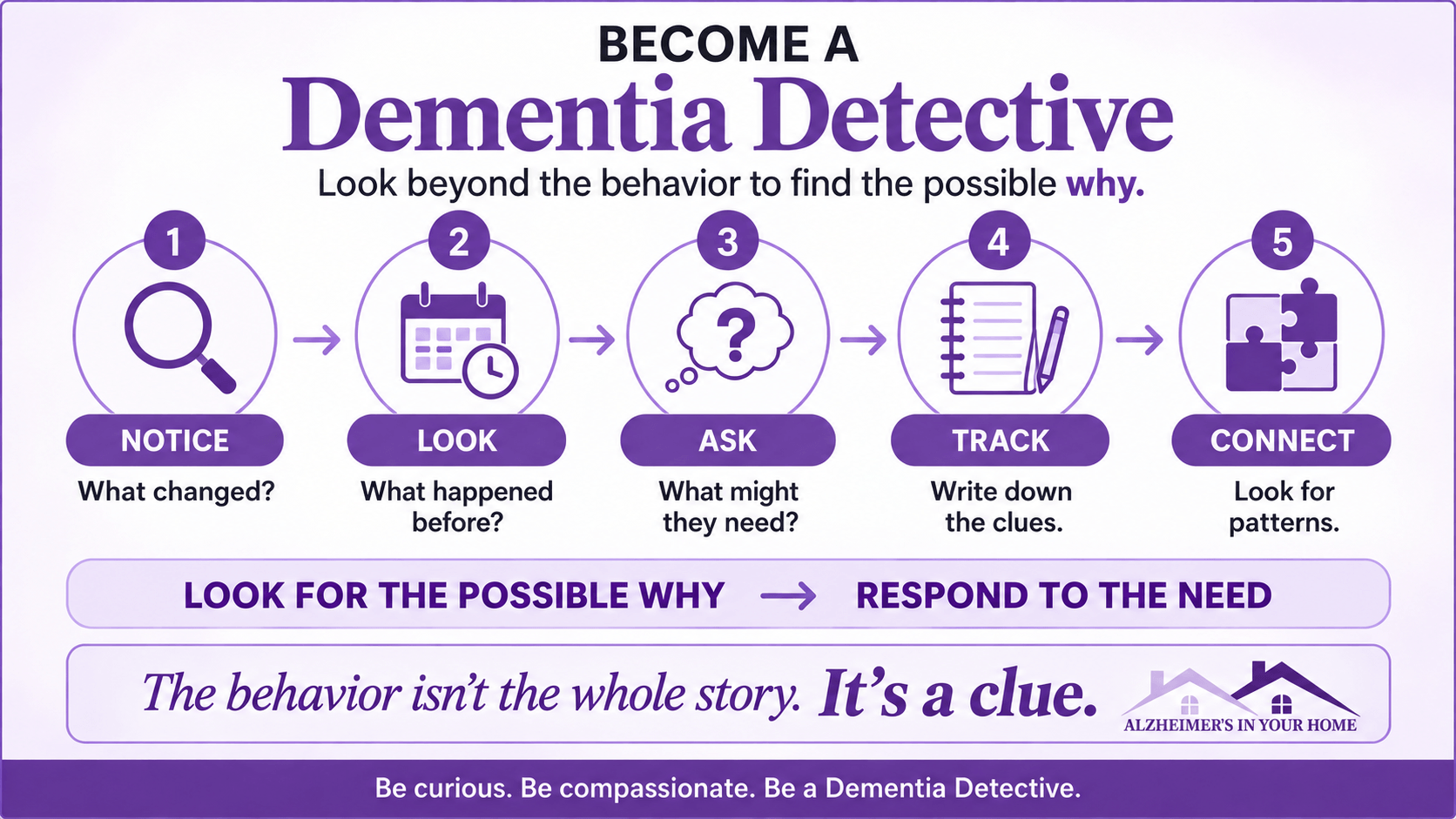
The five steps are:
NOTICE → LOOK → ASK → TRACK → CONNECT
.
💜 If you only look at the behavior, you may miss the most important clue.
What Is a Dementia Detective?
A Dementia Detective is a caregiver who gets curious about changes instead of simply labeling someone as difficult, stubborn, or uncooperative.
It does not mean you need to be a medical expert. It means learning to slow down and ask:
What might my loved one be trying to tell me?
As a Dementia Detective, you learn to:
- Notice exactly what changed
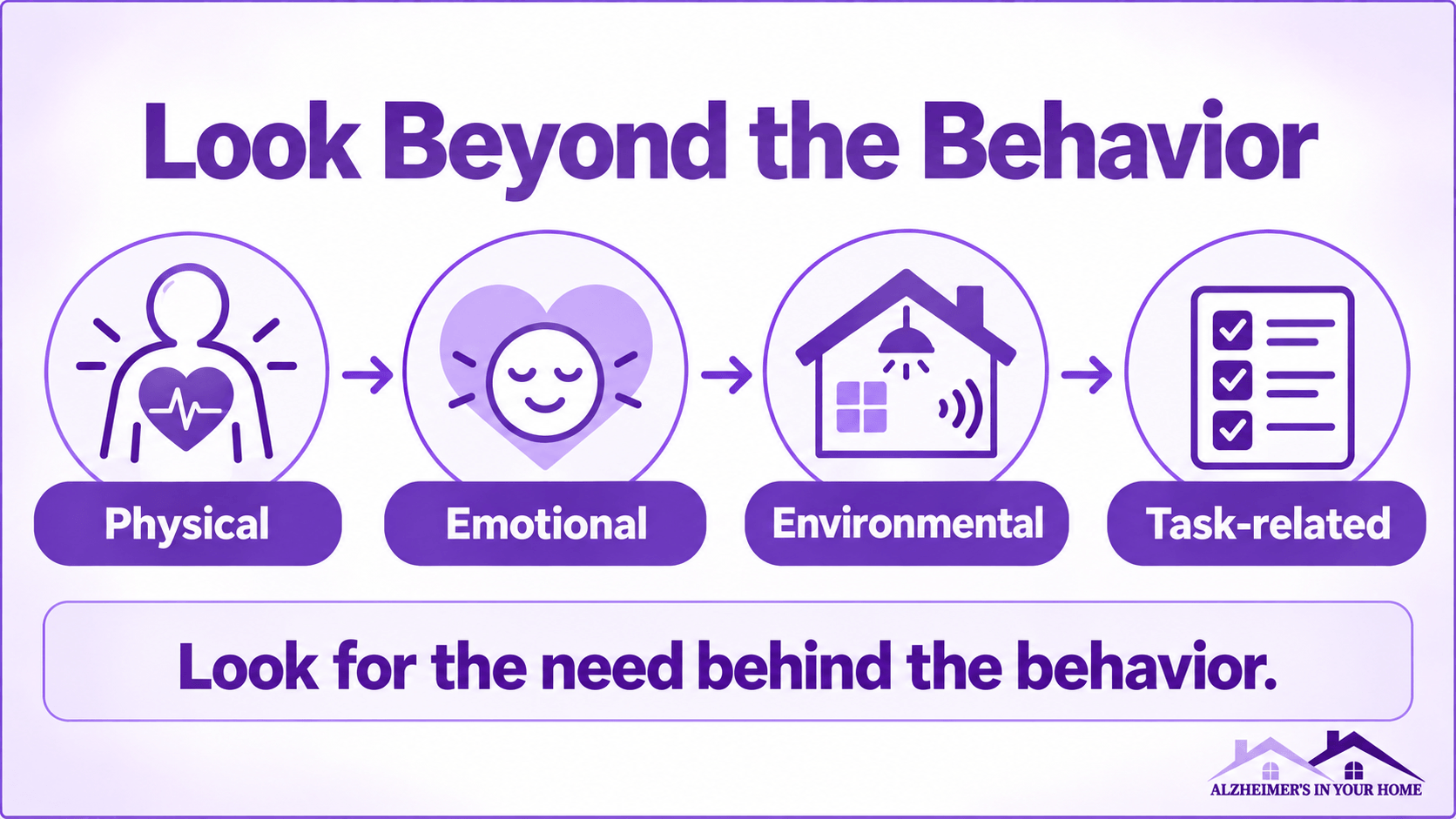
- Look for possible physical, emotional, or environmental causes
- Ask what the person may need
- Track what happened and what you tried
- Connect the clues to find a pattern
This process can help you respond to the person’s needs instead of only reacting to the behavior.
Why Behavior May Be Communication
Dementia affects much more than memory. It can change communication, judgment, reasoning, vision, emotions, and the ability to complete everyday tasks.
A person may feel pain but be unable to tell you where it hurts. They may be frightened by the shower but unable to explain why. They may push away a plate because chewing hurts or because they no longer recognize the food.
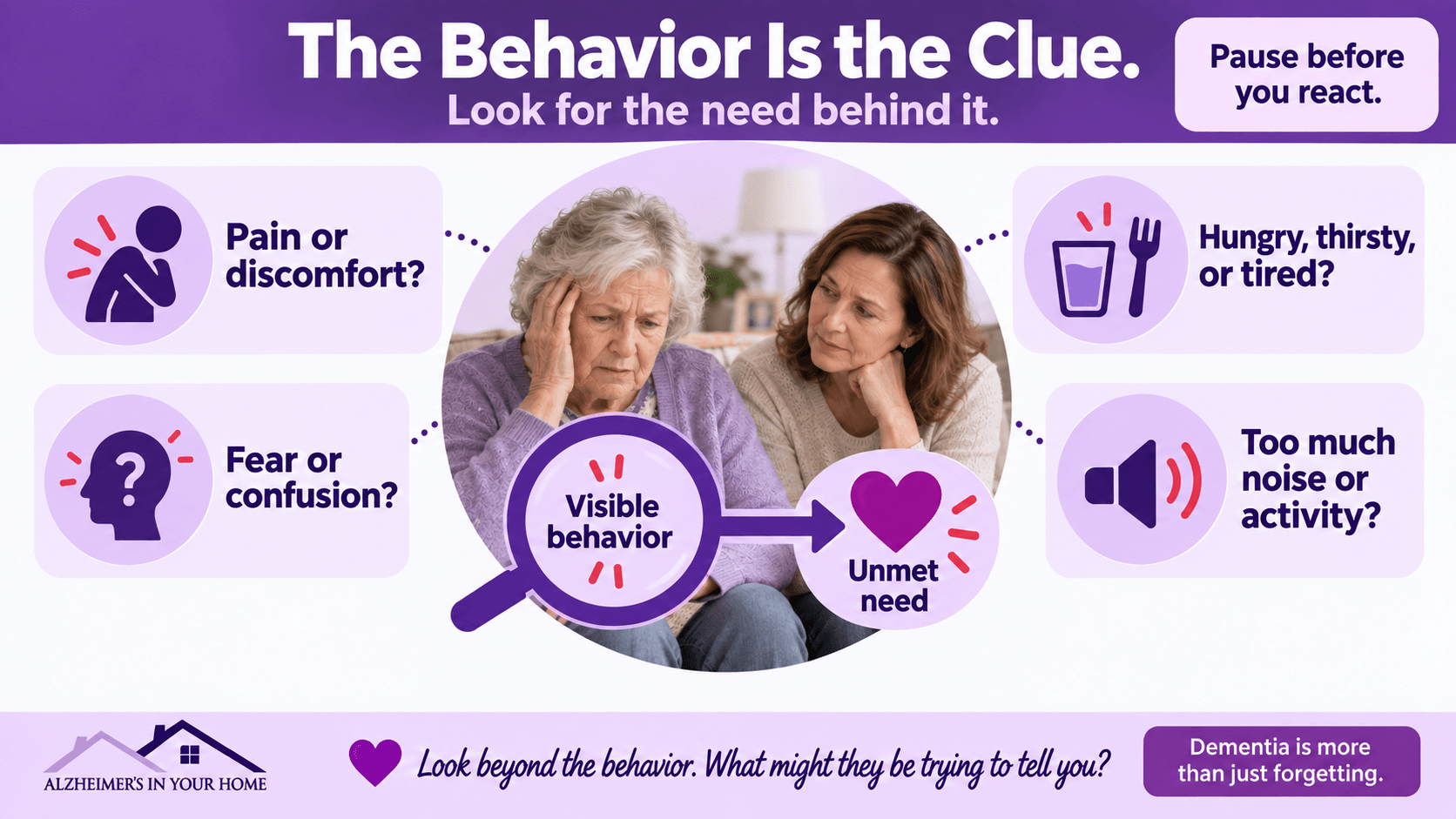
What looks like a behavior problem may be a response to:
- Pain or illness
- Hunger or thirst
- Constipation or the need to use the bathroom
- Fear or confusion
- Tiredness
- Too much noise or activity
- A task with too many steps
- A change in routine
- Feeling rushed, embarrassed, or out of control
This does not mean every behavior has one clear cause. Sometimes several things are happening at once. The goal is not to find someone to blame. The goal is to understand what may have changed.
🎥 Watch: How to Become a Dementia Detective
Sometimes it is easier to understand the Dementia Detective process when you can hear the steps explained and see how they work together.
In this video, I walk you through all five steps:
NOTICE → LOOK → ASK → TRACK → CONNECT
You will learn what to watch for, what questions to ask, what details to write down, and how to look for possible patterns behind changes in behavior.
Step 1: NOTICE What Has Changed
Begin with what you can see and hear.
Try not to use labels such as “aggressive,” “stubborn,” or “difficult.” These words do not give you enough information to find the cause.
Instead, describe exactly what happened.
Rather than writing:
“Mom was aggressive during her bath.”
Write:
“Mom yelled, pulled her arm away, and tried to stand when I began washing her left shoulder.”
That description gives you clues you can investigate.
Ask yourself:
- What did the person say or do?
- When did it happen?
- Where did it happen?
- Who was there?
- What happened right before it?
- Is this new?
- Did it begin suddenly or slowly?
- Is it happening more often?
- What is different from the person’s usual routine?
You do not have to understand the change yet. Your first job is simply to notice it clearly.
Step 2: LOOK for Possible Causes
Once you have described the change, begin looking for possible causes. Think about the whole person and what is happening around them.
Look for physical clues
Could the person be experiencing:
- Pain
- Hunger or thirst
- Constipation
- A need to use the bathroom
- Tiredness or poor sleep
- An infection or illness
- A medication change or side effect
- Trouble seeing or hearing
- Dental or mouth pain
- Difficulty chewing or swallowing
- Feeling too hot or too cold
A person with dementia may show pain by grimacing, guarding part of the body, moaning, withdrawing, becoming restless, or resisting care.
READ: Managing Pain in Dementia
Look for emotional clues
Could the person be feeling:
- Afraid
- Anxious
- Sad
- Lonely
- Frustrated
- Embarrassed
- Rushed
- Controlled
- Unsure of what is happening
The feeling behind the behavior may be more important than the words being spoken.
Look for environmental clues
Look around the room. Is there:
- Too much noise?
- Too many people?
- Poor lighting or shadows?
- A television playing in the background?
- Clutter or too many choices?
- An unfamiliar person or place?
- A room that is too hot or too cold?
- Something that could be misunderstood or frightening?
An environment that seems normal to you may feel confusing or overwhelming to a person with dementia.
Look at the task
Many everyday activities require more brain work than we realize.
Ask:
- Does the task have too many steps?
- Are the directions too long?
- Does the person understand what I am asking?
- Am I moving too quickly?
- Did I approach from where they could see me?
- Is the task causing pain or discomfort?
- Could we try a different way?
- Could we take a break and try again later?
Sometimes changing the approach can change the response.
💜 Don’t just ask, “How do I stop the behavior?” Ask, “What is the behavior trying to tell me?”
Step 3: ASK What the Person May Be Communicating
Now ask the most important question:
What might my loved one be trying to tell me?
The person may not be able to explain the answer, so watch their face, body movements, and reactions.
You can also use short, simple questions:
- “Does something hurt?”
- “Are you cold?”
- “Do you need the bathroom?”
- “Would you like to rest?”
- “Is this too loud?”
- “Would you like something different to eat?”
Ask one question at a time. Give the person extra time to answer. Avoid arguing or asking them to explain something they may not understand themselves.
Also ask yourself:
- Could they be frightened or confused?
- Is the task too hard right now?
- Are they trying to protect themselves?
- Do they need comfort, rest, food, fluids, or the bathroom?
- Could my tone, speed, or approach be adding to the stress?
This step is not about blaming the caregiver. We all become tired, rushed, and frustrated. It is about noticing what we may be able to change.
Step 4: TRACK What Happened
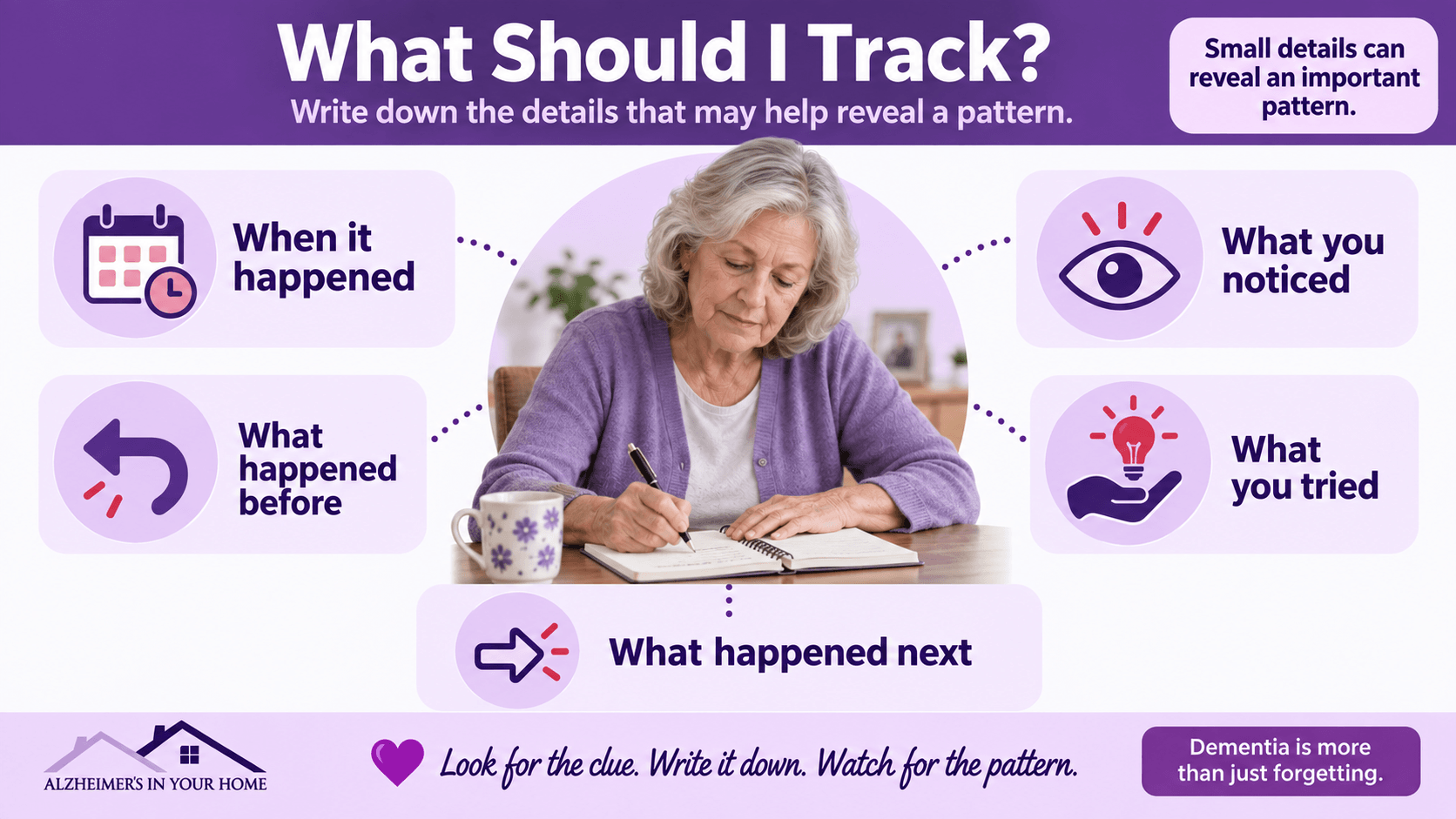
It is hard to remember every detail when you are providing care all day. Writing things down helps you keep the clues from getting lost.
Track:
- The date and time
- What happened
- Where it happened
- Who was present
- What happened right before it
- Sleep, meals, fluids, bathroom habits, pain, and medications
- What you tried
- Whether it helped
Here is a simple example:
| What to track | Example |
|---|---|
| Time | 6:30 p.m. |
| What happened | Dad paced and repeatedly said he needed to go home. |
| What happened before | The television was loud and several people were talking. |
| What we tried | We turned off the television and moved to a quiet room. |
| What happened next | He became calmer after about 15 minutes. |
Your notes do not need to be perfect. A few clear details can be more helpful than a long description written several days later.
Step 5: CONNECT the Clues
One difficult moment may not give you the answer. A pattern may begin to appear after you track the details for several days.
You might notice:
- Bathing resistance happens when a sore shoulder is moved.
- Agitation is worse after a poor night’s sleep.
- Eating becomes harder when the person is tired.
- Pacing happens shortly before they need the bathroom.
- Confusion increases in noisy or crowded places.
- Evening distress begins when shadows appear in the room.
- Personal care goes better when one person gives short directions.
Once you see a possible pattern, try one small change at a time.
You might:
- Lower the noise
- Improve the lighting
- Use shorter directions
- Offer a bathroom break
- Provide softer food
- Change the time of the activity
- Give the person time to rest
- Slow down your approach
- Stop and try again later
Then track what happens. Did the change help? Did the response stay the same? Did something become worse?
Changing one thing at a time makes it easier to tell what may be helping.
A Dementia Detective Story: When “Refusing to Eat” Is a Clue
Imagine that your mother has started turning her head away and pushing her dinner plate across the table. It would be easy to say she is refusing to eat.
But you decide to investigate.
NOTICE
You notice that she pushes away meat and crunchy foods but eats pudding and mashed potatoes.
LOOK
You watch more closely during the meal. She chews on only one side of her mouth and rubs her jaw.
ASK
You begin to wonder, “Could eating hurt?”
TRACK
You write down which foods she eats and which ones she pushes away. The pattern continues for two days.
CONNECT
You offer softer foods and contact her dentist. The dentist finds a sore area under her dentures.
What looked like “refusing to eat” was actually a clue that eating hurt.
Not every investigation will lead to such a clear answer. But without looking beyond the behavior, this clue could have been missed.
READ: Dementia Eating Problems
Do Not Blame Every Change on Dementia
A new behavior is not always caused by dementia getting worse.
Pain, dehydration, constipation, infection, medication changes, poor sleep, vision problems, hearing problems, and other health concerns can all affect how a person acts or functions.
A sudden or rapidly changing behavior deserves special attention. Contact the healthcare provider promptly when:
- Confusion or behavior changes suddenly
- The person is much sleepier or harder to wake
- There is new weakness or a change in balance
- You notice fever or possible signs of illness
- The person appears to be in pain
- They stop eating or drinking
- There has been a recent medication change
- The change is severe, frightening, or unsafe
Call 911 or seek emergency help for a life-threatening emergency, such as trouble breathing, signs of a stroke, a serious injury, or when the person cannot be kept safe.
When you are unsure, contact the person’s healthcare provider and explain what has changed.
READ: Dehydration in Dementia
Create a Record You Can Share
Your notes can help the healthcare team understand what is happening.
Instead of saying, “Dad has been acting strange,”
you may be able to say:
“For the past three evenings, Dad has started pacing around 6:30. It begins when the house becomes busy. He has also slept poorly and has not had a bowel movement in three days. Moving to a quiet room helps a little.”
That information gives the healthcare provider a clearer picture.
Tracking also helps other family members and caregivers know:
- What has changed
- What may trigger the response
- What has already been tried
- What seems to help
- What needs to be reported
Track the Clues With The Caregiver’s Notebook
I created The Caregiver’s Notebook to give dementia caregivers one place to record the important details of daily care.
It includes pages for tracking behaviors, pain, medications, meals, fluids, sleep, bathroom habits, vital signs, and other changes. These notes can help you notice patterns and prepare for conversations with the healthcare team.
You do not need to track everything every day. Begin with the change that concerns you most and write down the clues connected to it.

What If You Can’t Find the Cause?
You will not solve every behavior—and that does not mean you failed.
Dementia is complicated. There may be several causes at the same time. The person’s needs and abilities may also change from one day to the next.
When you cannot find the answer:
- Focus on safety
- Reduce stress around the person
- Offer comfort and reassurance
- Take a break when it is safe to do so
- Write down what happened
- Ask other caregivers what they noticed
- Contact the healthcare provider when you are concerned
The goal is not perfection. The goal is to understand the person a little better and respond with compassion.
You do not need to have every answer. Start by noticing one clue.
The Dementia Detective Process
The next time a behavior changes, remember these five steps:
- NOTICE what changed.
- LOOK for possible causes.
- ASK what the person may be communicating.
- TRACK the details and what you tried.
- CONNECT the clues to find possible patterns.
Behavior is not simply something to stop. It may be the clue that helps you understand what your loved one needs.
The behavior is the clue. Look for the need behind it.
Frequently Asked Questions
❓ What does it mean to be a Dementia Detective?
Being a Dementia Detective means looking beyond a change in behavior and searching for possible causes. You notice what changed, look for clues, ask what the person may need, track what happened, and connect the clues to find patterns.
❓ Why does behavior change with dementia?
Dementia can affect communication, judgment, reasoning, emotions, vision, and the ability to complete tasks. Behavior may also change because of pain, illness, fear, tiredness, hunger, thirst, an overwhelming environment, or another unmet need.
❓What should I track when a behavior happens?
Write down the time, place, what happened, who was present, what happened immediately before, and what you tried. It can also help to track sleep, meals, fluids, pain, bathroom habits, and medication changes.
❓ How long should I track a behavior?
Begin tracking as soon as you notice a change. Some patterns may appear after a few days. Do not wait to contact the healthcare provider if the change is sudden, severe, unsafe, or connected to signs of illness or pain.
❓What if I cannot find the cause?
You may not always find one clear cause. Focus on safety and comfort, reduce stress, keep tracking what you notice, and contact the healthcare provider when you are concerned.
❓ Can pain cause changes in dementia behavior?
Yes. A person who cannot explain their pain may become restless, withdrawn, upset, or resistant to care. Watch for facial expressions, guarding part of the body, changes in movement, moaning, or a sudden change from their usual behavior.
❓When should I call the doctor about a behavior change?
Contact the healthcare provider promptly when a behavior or confusion begins suddenly, becomes much worse, follows a medication change, or happens with pain, fever, weakness, unusual sleepiness, poor eating or drinking, or other signs of illness.
Additional Dementia Care Resources
Helpful next steps for caregivers:
🧠 How Dementia Affects the Brain and Changes Behavior
🔎 Understanding Dementia Behaviors
🤝 8 Reasons People With Dementia Refuse Care
💜 Something Has Changed. Now What?
When your loved one acts differently, it can be hard to know where to start. Get my free guide to help you notice changes, look for clues, and decide what to do next.
You’ll also receive my weekly Pearls of Wisdom for Dementia Caregivers, with practica