

When someone you love is living with dementia, it can feel like they’re becoming a different person.
Maybe they ask the same question over and over.
Maybe they accuse you of stealing something they misplaced.
Maybe they suddenly refuse to bathe, become angry over small things, or don’t recognize familiar places.
These changes can be confusing, heartbreaking, and exhausting.
One of the biggest lessons I’ve learned during my 30 years as a registered nurse—and while caring for my own parents with dementia—is this:
Most dementia behaviors make much more sense once you understand what’s happening inside the brain.
Dementia is much more than memory loss. It changes the way the brain receives information, processes it, stores it, and responds to the world.
When caregivers understand these changes, they often stop asking, “Why are they doing this?” and begin asking, “What is their brain struggling to do?”
That simple shift can completely change the way you care for someone with dementia.
🎥 Prefer to Watch?
In this video, I explain what dementia really does to the brain and why those changes can affect behavior, communication, vision, reasoning, and everyday tasks.
🧠 Key Takeaways
✓ Dementia affects much more than memory. Brain changes can affect judgment, reasoning, communication, vision, emotions, and everyday tasks.
✓ Behavior may be a sign of confusion. What looks like stubbornness or refusal may actually come from fear or difficulty processing information.
✓ Change the question. Instead of asking “Why are they doing this?” try asking “What is their brain having trouble doing right now?”
Dementia Is More Than Forgetting
Many people believe dementia only affects memory.
While memory loss is often one of the first signs, dementia affects almost every part of the brain as the disease progresses.
It can change a person’s ability to:
- Think clearly
- Solve problems
- Make decisions
- Use language
- Understand what they see
- Judge distances
- Manage emotions
- Plan simple tasks
- Recognize danger
- Control impulses
- Understand time
- Understand where they are
That’s why someone with dementia may remember a childhood friend but forget they just ate lunch.
The disease isn’t simply erasing memories.
It’s changing how the brain works.
💜 “Dementia is more than forgetting. It changes how the brain understands and responds to the world.”
What Happens Inside the Brain?
The brain contains billions of nerve cells called neurons.
These cells communicate by sending messages back and forth every second.
Those messages allow us to think, remember, speak, move, recognize people, and understand what’s happening around us.
With Alzheimer’s disease and many other dementias, these brain cells become damaged.
Over time:
- Brain cells stop communicating properly.
- Connections between cells are lost.
- More brain cells die.
- Parts of the brain begin to shrink.
As more areas become damaged, the brain has a harder time doing everyday tasks that once seemed automatic.
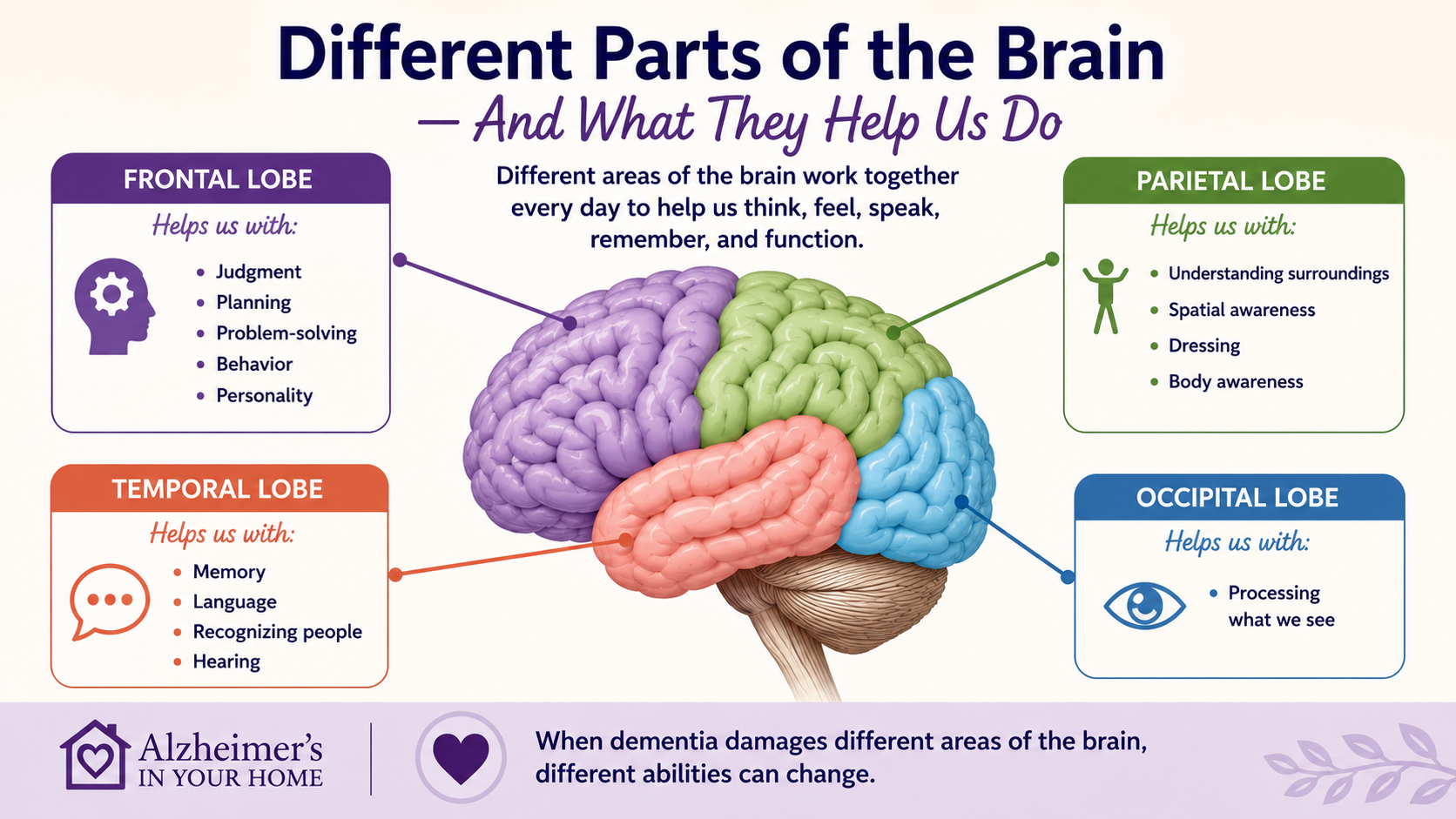
Different Parts of the Brain Control Different Abilities
One reason dementia looks different from person to person is that different parts of the brain are affected.
For example:
The Frontal Lobe
This area helps with:
- Judgment
- Planning
- Problem-solving
- Self-control
- Decision-making
When this area is damaged, a person may:
- Say things they normally wouldn’t.
- Make unsafe decisions.
- Lose their social filter.
- Have trouble starting simple tasks.
The Temporal Lobes
These areas help with:
- Memory
- Understanding language
- Recognizing familiar people
Damage here can lead to:
- Repeating questions
- Forgetting recent conversations
- Difficulty finding words
- Confusing family members
The Parietal Lobes
These help the brain understand what it sees and where objects are located.
Damage can make someone:
- Miss food on one side of the plate
- Misjudge distances
- Have trouble getting dressed
- Become confused in familiar places
The Occipital Lobe
This area processes vision.
Even if eyesight is normal, the brain may not correctly interpret what the eyes are seeing.
That’s why someone may mistake:
- A dark rug for a hole
- Shadows for animals
- Reflections for strangers
- Patterns on carpet for objects
Why Behaviors Change
One of the hardest parts of dementia is understanding behavior changes.
Many caregivers think:
“They’re just being difficult.”
“They’re doing this on purpose.”
“They’re trying to upset me.”
In reality, that’s usually not what’s happening.
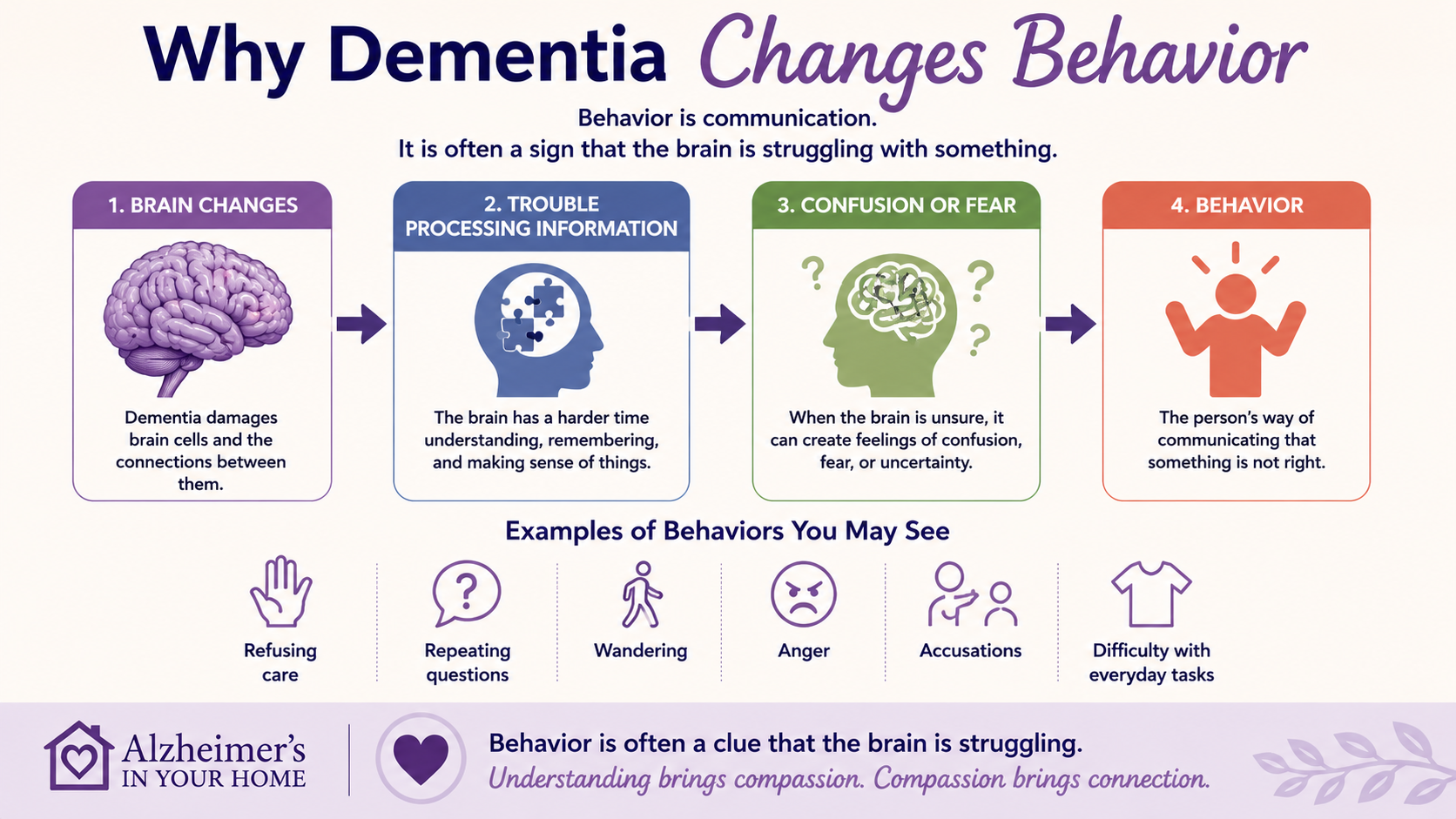
Behavior is often the brain’s way of communicating that something isn’t working.
For example:
Someone may become angry because they can’t understand what you’re asking.
They may refuse a bath because they no longer understand why they need one.
They may lash out because they’re frightened.
Or they may wander because they feel they’re supposed to be somewhere else.
Behavior is often the symptom.
The real problem is what’s happening inside the brain.
💜 “Behavior is often the symptom. The real problem may be what the brain is struggling to understand.”
Why Logic Stops Working
One of the most frustrating parts of caregiving is realizing that logic no longer works.
You may explain something five different ways.
You may show proof.
You may calmly repeat yourself.
But dementia damages the parts of the brain needed to understand reasoning.
That’s why arguing usually makes things worse.
Instead of trying to convince your loved one they’re wrong, it often helps to step into their reality and respond to the emotion they’re feeling.
This approach is called validation, and it helps reduce fear and frustration for both of you.
💜 “When logic no longer works, more explaining usually doesn’t create more understanding.”
Why Familiar Tasks Become Difficult
As dementia progresses, everyday activities become harder.
Not because the person is lazy.
Not because they don’t care.
But because the brain can no longer organize the steps.
Something as simple as brushing teeth actually requires many separate brain functions:
- Remembering to brush
- Finding the toothbrush
- Putting toothpaste on it
- Knowing what to do next
- Remembering when they’re finished
If even one step is affected, the whole task may become confusing.
💜 “Sometimes we aren’t asking too much of the person. We’re asking too much of their brain at one time.”
Why Communication Changes
Communication problems aren’t only about forgetting words.
The brain may struggle to:
- Understand what was said
- Find the right words
- Follow conversations
- Read facial expressions
- Process information quickly
That’s why speaking slowly, using short sentences, and asking one question at a time can make such a difference.
Giving the brain extra time to process information often works better than repeating yourself louder.
What This Means for Caregivers
Understanding the brain changes can completely change how you respond.
Instead of thinking:
“They’re being stubborn.”
You begin thinking:
“They may not understand.”
Instead of saying:
“I already told you that.”
You might respond:
“I know this feels confusing. Let’s figure it out together.”
Small changes like these often reduce stress for everyone.
💜 “Instead of asking, ‘Why are they doing this?’ ask, ‘What is their brain having trouble doing right now?’”
One Lesson I’ll Never Forget
During my years as a nurse, I cared for many people whose families believed they were intentionally refusing care.
But when we slowed down, changed our approach, and looked at what the person’s brain was struggling to do, their behavior often made perfect sense.
I’ve seen someone refuse a shower because they thought the dark floor was a deep hole.
I’ve seen someone become frightened because they didn’t recognize their own reflection.
I’ve watched families stop arguing and start connecting simply because they understood that the disease—not their loved one—was causing the behavior.
Those moments are why I spend so much time teaching caregivers about the dementia brain.
Understanding what the brain can no longer do changes everything.
Common Questions About Dementia and the Brain
❓If my loved one remembers things from years ago, why can't they remember what I just told them?
Older memories and newer memories are stored and retrieved differently. Alzheimer’s disease often affects the ability to make and hold onto new memories earlier in the disease. That’s why someone may tell you detailed stories from 40 years ago but not remember what they ate for breakfast.
❓ Why can my loved one do something one day but not the next?
Dementia abilities can vary from day to day—and sometimes even from hour to hour. Fatigue, pain, illness, stress, hunger, medications, poor sleep, and too much activity can make thinking and processing harder.
Instead of assuming they should be able to do something because they did it yesterday, meet them where their abilities are today.
❓Is my loved one being stubborn when they refuse to do something?
What looks like stubbornness may actually be confusion, fear, pain, difficulty understanding what you’re asking, or not knowing how to complete the task.
Before pushing harder, stop and ask:
“What might be making this difficult for them?”
Sometimes changing your approach works much better than repeating the request.
❓ Why does arguing with someone with dementia usually make things worse?
Dementia can damage the parts of the brain needed for reasoning, judgment, and processing information.
Your explanation may make perfect sense to you, but their brain may no longer be able to follow the logic.
Instead of trying to prove that they’re wrong, respond to the feeling behind what they’re saying.
❓Can dementia change what a person sees even if their eyesight is good?
Yes. The eyes collect visual information, but the brain has to make sense of it.
Dementia can affect how the brain interprets what a person sees. Shadows, dark rugs, mirrors, patterns, or changes in depth may become confusing or frightening.
This is why the environment can play such an important role in dementia care.
❓Are all behavior changes caused by dementia?
No—and this one is important.
A sudden or unusual change in behavior or confusion should not automatically be blamed on dementia.
Pain, infection, dehydration, constipation, medication changes, lack of sleep, and other medical problems can cause changes too.
If your loved one has a sudden change from their usual behavior or thinking, contact their healthcare provider.
You Don’t Have to Figure This Out Alone
Dementia caregiving is hard.
But it becomes a little less overwhelming when you understand why these changes are happening.
Every new piece of knowledge helps you respond with more confidence, patience, and compassion.
Remember, your loved one isn’t trying to give you a hard time.
They’re having a hard time because their brain is changing.
When we understand the disease, we can become better dementia partners.
Learn More in the Understanding Dementia Course
If this article helped you understand dementia a little better, you’ll love the Understanding Dementia Course.
Inside the course, I walk you through:
- What dementia really is
- The differences between Alzheimer’s disease and other dementias
- How the brain changes over time
- The stages of dementia
- Why behaviors happen
- Communication techniques that reduce frustration
- Practical caregiving strategies you can use every day
The lessons are simple, easy to follow, and filled with real-life examples from my years as a registered nurse and from caring for my own parents with dementia.
Whether you’re a brand-new caregiver or have been on this journey for years, you’ll gain practical knowledge that helps you care with greater confidence.
💜 Get a Little Dementia Caregiver Support Each Week
Caring for someone with dementia can bring a new question almost every day.
Join me each week for Pearls of Wisdom for Dementia Caregivers, where I share practical caregiving tips, simple dementia education, helpful resources, and encouragement for the journey ahead.