


“I Want to Go Home”: What Does It Mean in Dementia?
When someone with dementia keeps asking to go home—even when they are already home—they may be trying to tell you something.
Hearing “I want to go home” over and over can be confusing, frustrating, and heartbreaking for families.
You may explain:
“But you ARE home.”
They may look around and insist:
“No, this isn’t my home. I need to go home.”
It can feel like nothing you say gets through.
But instead of focusing only on the words “go home,” try looking a little deeper.
For someone living with dementia, home may not mean a particular house or address.
Home may mean safety. Familiarity. Comfort. Family. A time in their life when the world made more sense.
🔎 Don’t argue about where they are. Look for the need behind the words.
Why Does Someone With Dementia Ask to Go Home?
Dementia changes how the brain understands memories, time, surroundings, and what is happening right now.
A person may no longer recognize the house they have lived in for many years. At the same time, memories of a childhood home or a home from decades ago may still feel very real.
They may even believe they are much younger than they actually are.
So when they say “I want to go home,” they may be thinking about a home from another time in their life.
But sometimes they aren’t really asking for a house at all.

🏠 “Home” Might Mean…
❤️ I want to feel safe.
🏠 I want somewhere familiar.
👩 I’m looking for someone I miss.
😟 I’m frightened or confused.
😴 I’m tired or overwhelmed.
🚽 I need something, but I can’t tell you what it is.
Sometimes “I want to go home” really means “I don’t feel right here.”
That changes the question from:
“How do I convince them they’re already home?”
to:
“What are they trying to tell me?”
Don’t Try to Prove They Are Home
It is completely natural to respond:
“But you ARE home!”
Or:
“You’ve lived here for 20 years!”
You know that’s true.
But their brain may be telling them something very different.
Trying harder to prove that they are home may lead to more arguing, fear, anger, or frustration.
Think about what it would feel like if you were absolutely certain you were somewhere you didn’t belong—and everyone around you kept telling you that you were wrong.
Instead of correcting the facts, respond to the feeling.
💬 What Can I Say Instead?
You don’t need a perfect response. Your goal is to help the person feel heard, safe, and reassured.
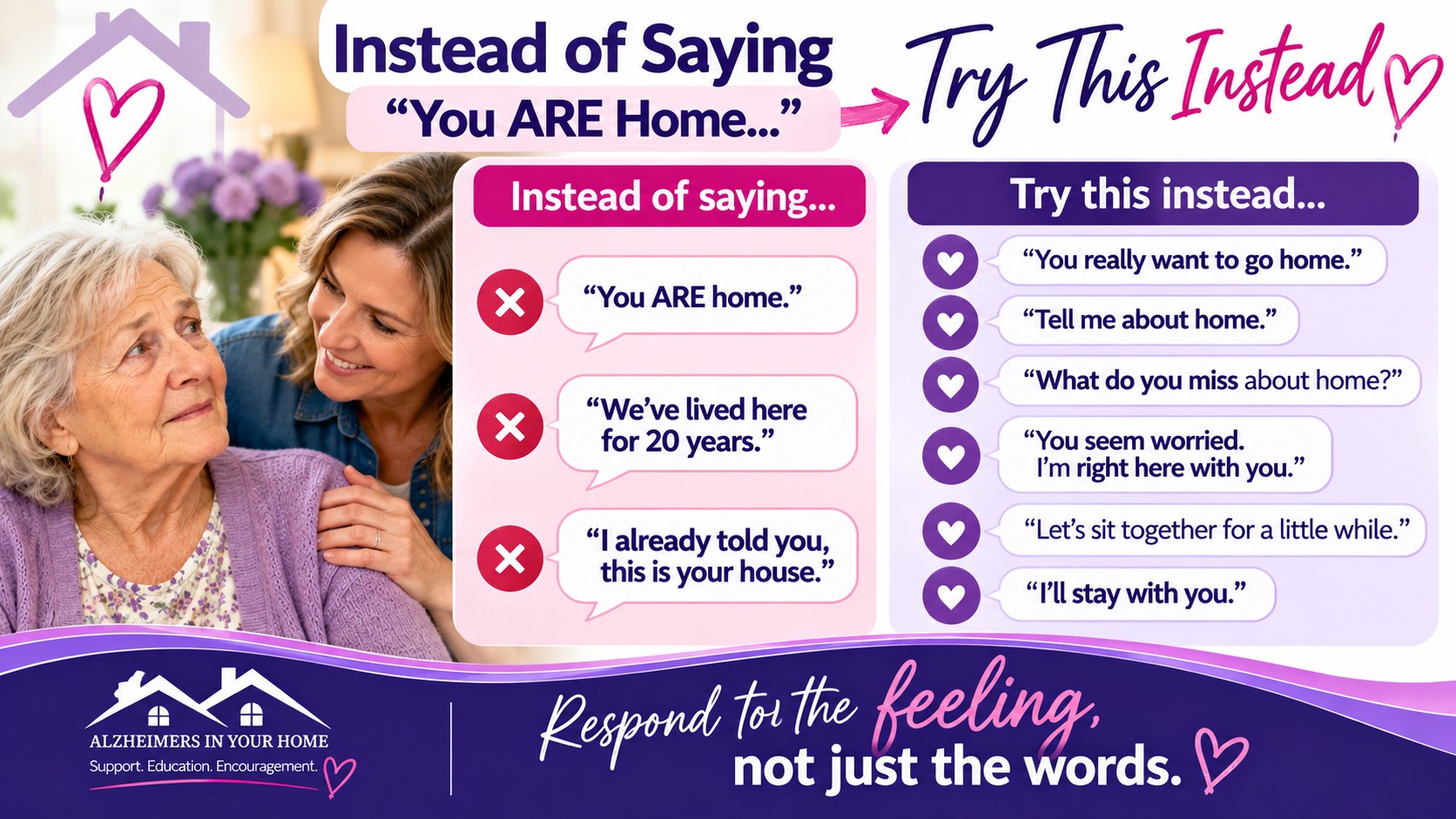
Instead of:
❌ “You ARE home.”
Try:
💜 “You really want to go home.”
💜 “Tell me about home.”
💜 “What do you miss about home?”
💜 “You seem worried. I’m right here with you.”
💜 “Let’s sit together for a little while.”
💜 “I’ll stay with you.”
Listen to their answer.
They may start talking about their mother, their children, a job they once had, a childhood home, or something they believe they need to do.
That conversation may give you the clue you’re looking for.
🔎 Become a Dementia Detective
Want to learn the whole process? Become a Dementia Detective and learn how to look for the WHY →
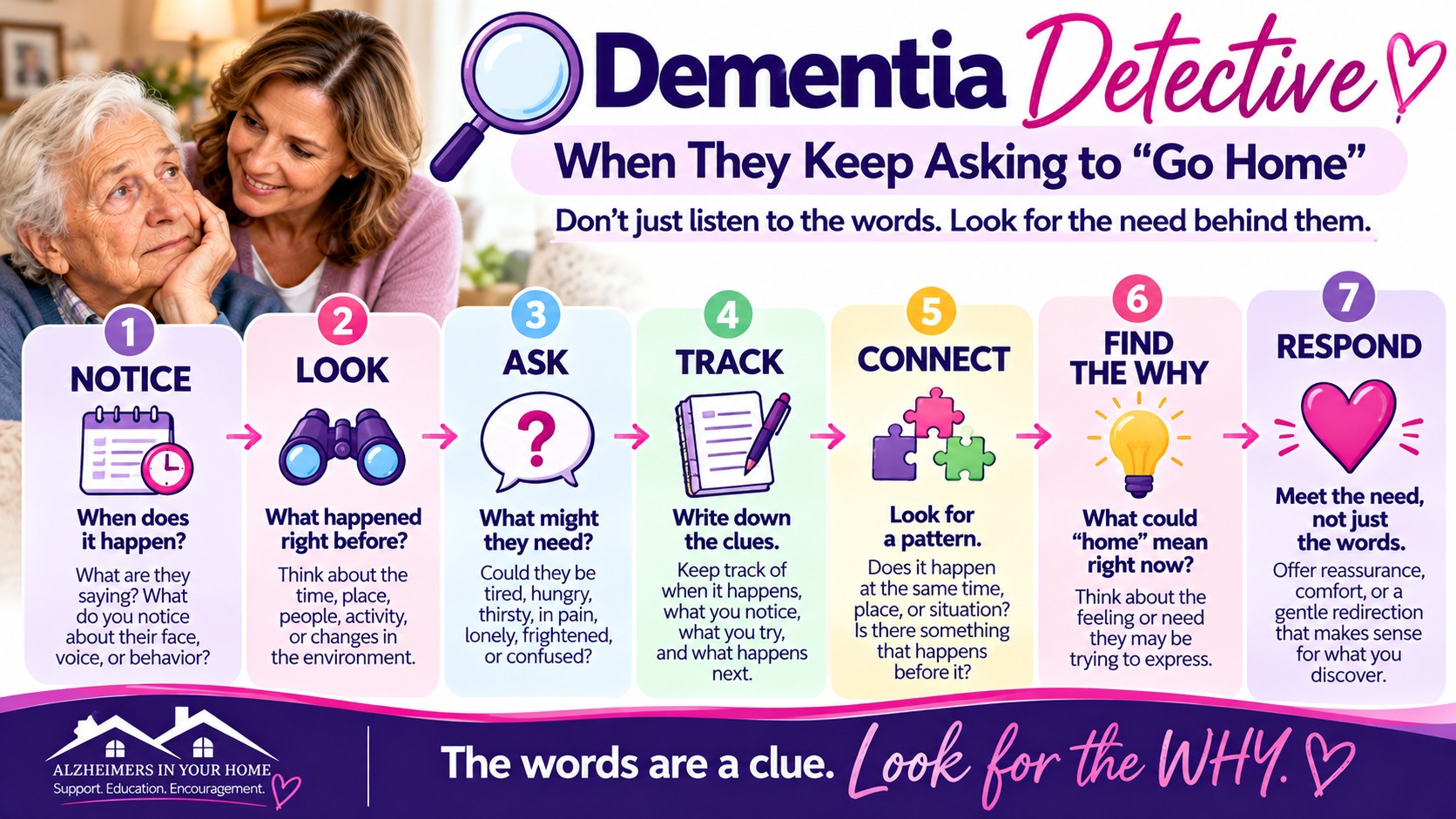
Start looking for a pattern.
1. NOTICE — What changed?
When are they asking to go home?
What are they saying?
What does their face, voice, or body language tell you?
Are they frightened? Restless? Angry? Tearful? Looking for something?
2. LOOK — What happened before?
Think about what was happening right before they asked.
Did someone leave?
Did the room become noisy?
Was personal care happening?
Did they just wake up?
Is it getting dark outside?
3. ASK — What might they need?
Could they be:
- Tired?
- Hungry or thirsty?
- In pain?
- Needing the bathroom?
- Lonely?
- Frightened?
- Overstimulated?
- Looking for someone?
- Unsure of where they are?
4. TRACK — Write down the clues
If this happens repeatedly, write down:
When it happened → What happened before → What you noticed → What you tried → What happened next
You don’t have to remember everything.
Writing it down can make a pattern much easier to see.
5. CONNECT — Look for patterns
Does asking to go home happen at about the same time every day?
Does it happen around certain people?
After certain activities?
When the house becomes busy?
When they’re tired?
Once you find a pattern, you may begin to understand WHY it is happening.
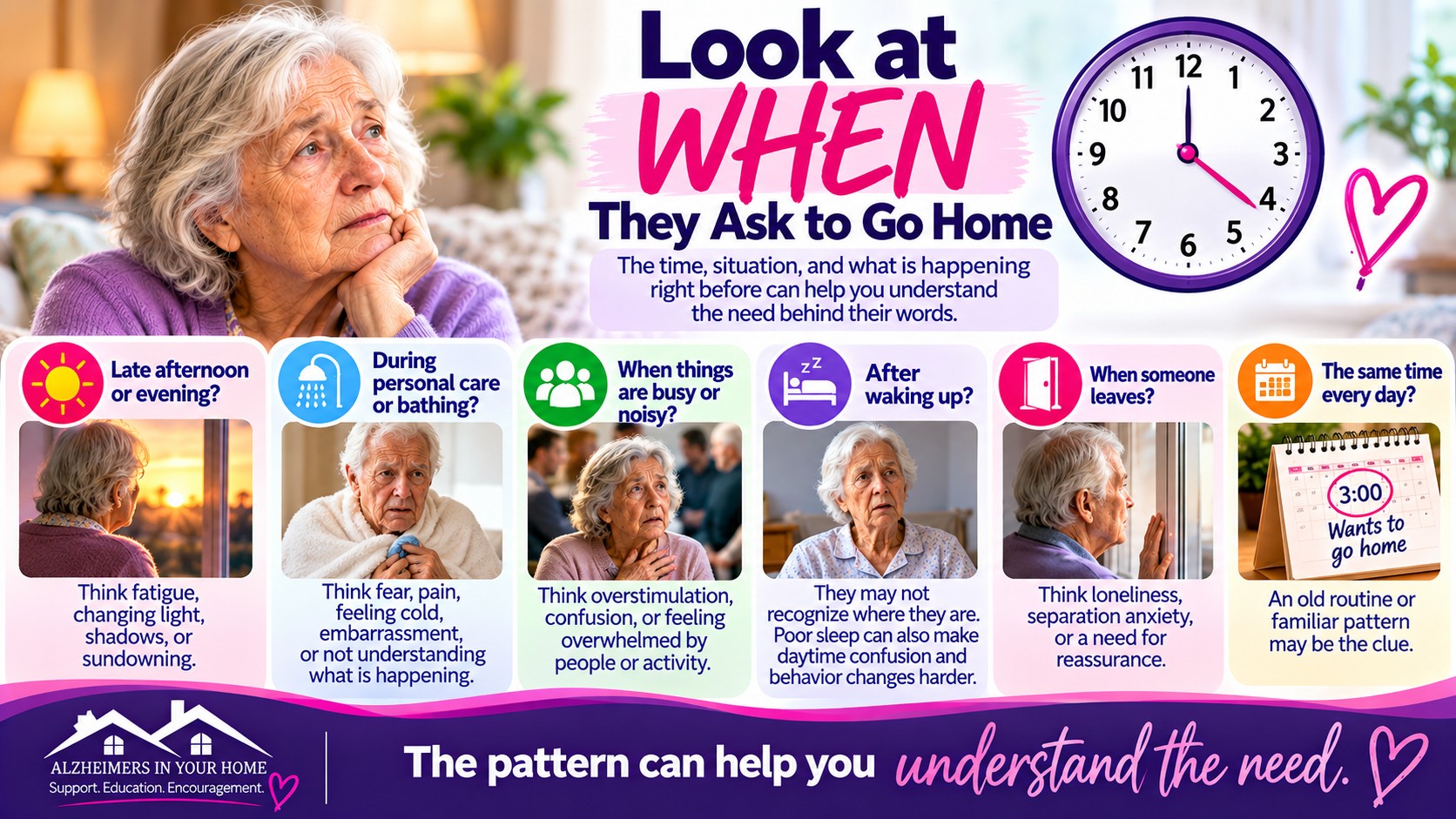
Look at WHEN They Want to Go Home
The timing can give you important clues.
🌇 Every afternoon or evening?
Late-day confusion, fatigue, changing light, shadows, or sundowning may be contributing.
Learn more about sundowning and why late-day changes happen →
🚿 During bathing or personal care?
If this happens during bathing, don’t assume they’re simply refusing the bath. Fear, pain, feeling cold, embarrassment, or not understanding what is happening may all play a part.
Learn why bathing can become difficult for someone with dementia →
👥 When the house is busy?
Noise, visitors, television, conversations, or too much activity may become overwhelming.
😴 After waking up?
For a few moments, they may not recognize where they are. Poor sleep can also make daytime confusion and behavior changes harder.
Learn why your loved one may be up at night →
🚪 When someone leaves?
They may be looking for security, companionship, or someone they remember from another time.
🍽️ Around the same time each day?
An old routine may still be deeply rooted in their memory.
Maybe that was when they used to leave work, pick up the children, start dinner, or go somewhere important.
The pattern may help tell the story.
What Can You Try?
Once you’ve acknowledged how they feel, gently try something that provides comfort or changes their focus.
💜 Reassure
Try:
“You’re safe. I’m here with you.”
Sometimes reassurance is more helpful than an explanation.
🎵 Redirect gently
Offer something familiar or comforting:
- Favorite music
- A snack or drink
- Looking through photographs
- Folding towels
- Sitting together
- Going for a short walk
- Helping prepare a meal
- A familiar television program
Redirection isn’t about tricking someone.
It is helping their brain move away from something that is causing distress.
🏠 Make the surroundings feel familiar
Look around the room.
Could photographs, familiar furniture, favorite blankets, meaningful objects, or better lighting make the space feel more recognizable?
Also look for things that could be confusing, such as shadows, reflections, clutter, or unfamiliar objects.
❤️ Check for an unmet need
Don’t assume every request to go home is caused by dementia.
Ask yourself:
Could something hurt?
Pain can be easy to miss when someone can no longer explain where or how they hurt.
Learn how to recognize possible signs of pain in dementia →
Do they need the bathroom?
Are they hungry or thirsty?
Not drinking enough can also contribute to changes in how someone feels and functions.
Learn the warning signs of dehydration in dementia →
Are they too hot or cold?
Are they exhausted?
Are they frightened or lonely?
Behavior can be one of the ways a person with dementia communicates a need.
A Dementia Detective Example
Imagine Mary asks to go home almost every afternoon around 4:30.
Her daughter responds:
“Mom, you ARE home.”
But Mary becomes more upset. She walks toward the door and insists she needs to leave.
Instead of continuing to argue, her daughter begins writing down when this happens.
She notices something.
It almost always starts around 4:30.
For many years, Mary finished work around that time, drove home, and started dinner for her family.
That old routine may still feel very real to her.
The next afternoon, when Mary becomes restless and says she needs to go home, her daughter doesn’t argue.
She says:
“You’re ready to get going. Come help me get dinner started.”
They walk into the kitchen together.
Mary settles down.
Did her daughter prove to Mary that she was already home?
No.
She did something more helpful.
She responded to the need instead of arguing with the words.
🚪 What If They Try to Leave?
Sometimes saying “I want to go home” progresses to trying to leave the house.
At that point, safety becomes especially important.
Avoid physically confronting the person unless there is an immediate safety danger. An argument at the door can quickly increase fear and agitation.
Instead, try to redirect them away from the door while you address whatever may be driving the need to leave.
If wandering or exit-seeking is becoming a concern, take steps to make the home safer and have a plan in case your loved one does leave.
If your loved one is wandering or trying to leave the house, learn what you can do to reduce the risk and prepare in case they do get out.
Learn more about wandering and dementia safety →
⚠️ What If This Behavior Is Suddenly New?
Pay attention when “I want to go home” or attempts to leave are a sudden change from the person’s usual behavior.
A sudden increase in confusion, agitation, restlessness, or other behavior changes should not automatically be blamed on dementia.
Changes can sometimes be related to things such as:
- Pain
- Illness
- Infection
- Dehydration
- Constipation
- Medication changes
- Poor sleep
- Other medical problems
If you notice a sudden or significant change, contact their healthcare provider and share what you are seeing. Seek urgent medical care for severe or concerning symptoms.
A sudden behavior change is a clue worth investigating.
Learn how to look for possible causes behind dementia behavior changes →
This is another reason tracking changes can be so helpful.
You Don’t Have to Win the Argument
When someone with dementia says “I want to go home,” you may not be able to convince them that they are already there.
And you don’t have to.
Instead:
Slow down.
Listen to the words.
Watch what is happening around them.
Look for patterns.
Ask what they might need.
You may discover they aren’t really asking for a house.
They may be asking to feel safe, familiar, comfortable, or connected.
💜 The behavior isn’t the whole story. It’s a clue.
Frequently Asked Questions About “I Want to Go Home”
❓ Why does someone with dementia say, “I want to go home,” when they are already home?
But “home” may also mean more than a place. They may be looking for a feeling of safety, comfort, familiarity, or connection. Instead of focusing only on the words, try to figure out what they may be needing at that moment.
❓ Should I tell them, “You are already home”?
Try responding to the feeling instead:
“You really want to go home. Tell me about home.”
Or:
“You seem worried. I’m right here with you.”
You do not have to convince them that they are wrong. Your goal is to help them feel safe.
❓What should I say when someone with dementia wants to go home?
You might say:
“What do you miss about home?”
“Tell me about your home.”
“I’ll stay with you.”
“Let’s sit together for a little while.”
Listen to their answer. It may give you an important clue about what “home” means to them.
❓ Why do they keep asking to go home over and over?
But repeated asking can also be a clue.
Pay attention to when it happens. Is it late in the afternoon? After waking? When the house gets busy? During personal care? When a certain person leaves?
A pattern may help you discover the reason behind the words.
❓Is asking to go home part of sundowning?
If “I want to go home” happens mostly later in the day, look at possible triggers such as fatigue, hunger, pain, changing light, shadows, too much activity, or a disrupted routine.
❓ What if they try to leave the house to “go home”?
Avoid arguing or physically blocking them unless there is an immediate danger. Try reassurance and gentle redirection first. You might walk with them for a few minutes, offer a snack, look through familiar photos, or move together to another activity.
If they are trying to leave repeatedly, you will also want to look closely at when it happens and what happens right before it.
❓Could pain or another physical problem cause them to ask to go home?
Think about pain, hunger, thirst, constipation, needing the bathroom, fatigue, medication changes, illness, or another source of discomfort.
A sudden or significant change from your loved one’s normal behavior should be discussed with their healthcare provider.
❓What if nothing I try works?
This is where becoming a Dementia Detective can really help. Write down when it happens, what was happening beforehand, what your loved one said or did, what you tried, and what happened next.
Over several days, you may begin to see a pattern that wasn’t obvious before.
The words are the clue. Look for the WHY.
When someone with dementia says, “I want to go home,” don’t just ask, “How do I stop them from saying this?”
Instead ask:
“What might they be trying to tell me?”
🔎 Ready to Start Looking for the WHY?
When the same behavior keeps happening, you don’t have to guess.
Become a Dementia Detective
Learn how to use NOTICE → LOOK → ASK → TRACK → CONNECT to look beyond the behavior and search for the need behind it.

📓 Write Down the Clues
Patterns can be hard to see when you’re living through them every day.
The Caregiver’s Notebook gives you one place to track changes in sleep, eating, pain, behavior, medications, personal care, and more—so you can spot patterns and share what you’re seeing with the healthcare team.

💜 Notice the clues. Track the changes. Find the pattern.
Additional Dementia Care Resources
Helpful next steps for caregivers:
💜 Something Has Changed. Now What?
When your loved one acts differently, it can be hard to know where to start. Get my free guide to help you notice changes, look for clues, and decide what to do next.
You’ll also receive my weekly Pearls of Wisdom for Dementia Caregivers, with practica